
CVE-2026-69414 ShieldBreak Zero-Day: No Patch, and CISA BOD 26-04 Gives You 14 Days

Last updated on: September 3, 2026
Executive Summary
ShieldBreak (CVE-2026-69414) is a zero-day elevation-of-privilege vulnerability in the Microsoft Malware Protection Engine used by Microsoft Defender, allowing a low-privilege local attacker to escalate to SYSTEM. A public PoC was released on August 12, 2026, and Microsoft assigned the CVE on August 14, and no patch is available yet. Qualys VMDR provides detection across Windows environments, and Qualys TruRisk Eliminate offers a mitigation that teams can apply now, with affected assets reassessable in VMDR to verify remediation.

Average ShieldBreak exposure observed across various organizations
ShieldBreak, tracked as CVE-2026-69414, is a zero-day vulnerability that emerged shortly after Microsoft released a fix for RoguePlanet (CVE-2026-50656), another Microsoft Defender privilege-escalation vulnerability.

On August 12, 2026, a publicly available PoC for ShieldBreak was released, showing how a low-privileged local attacker could escalate to SYSTEM. Microsoft assigned CVE-2026-69414 on August 14, 2026, and is developing a security update; no patch is available yet.
What Is ShieldBreak?
ShieldBreak is an elevation-of-privilege vulnerability in the Microsoft Malware Protection Engine used by Microsoft Defender. It targets a privileged Defender processing path that can be abused by a local attacker to cross the Windows security boundary and gain SYSTEM-level privileges.
How ShieldBreak Turns Defender into a Privilege-Escalation Path?
ShieldBreak targets how Microsoft Defender processes files during cloud-file hydration. The exploit uses a user-mode callback to interfere with the file data Defender receives through the Cloud Filter API (CFAPI). It also uses Windows filesystem and Object Manager mechanisms to influence which file Defender ultimately scans.
This gives the attacker control over part of a process that runs with Defender’s elevated privileges. By getting Defender to process attacker-controlled content, ShieldBreak can turn that privileged operation into code execution as NT AUTHORITY\SYSTEM, allowing a low-privileged local attacker to escalate privileges. The public PoC was reported to work on Windows 11 25H2 and Windows Server 2025.
Detecting CVE-2026-69414 with Qualys VMDR
Qualys VMDR provides comprehensive detection and visibility for CVE-2026-69414 (ShieldBreak) across your Windows environment.
Use the following QQL query to identify all assets flagged for ShieldBreak in VMDR:
vulnerabilities.vulnerability.cveIds:CVE-2026-69414

Mitigating ShieldBreak Now with TruRisk Eliminate
ShieldBreak does not yet have a Microsoft patch, but organizations do not have to stay exposed while they wait.
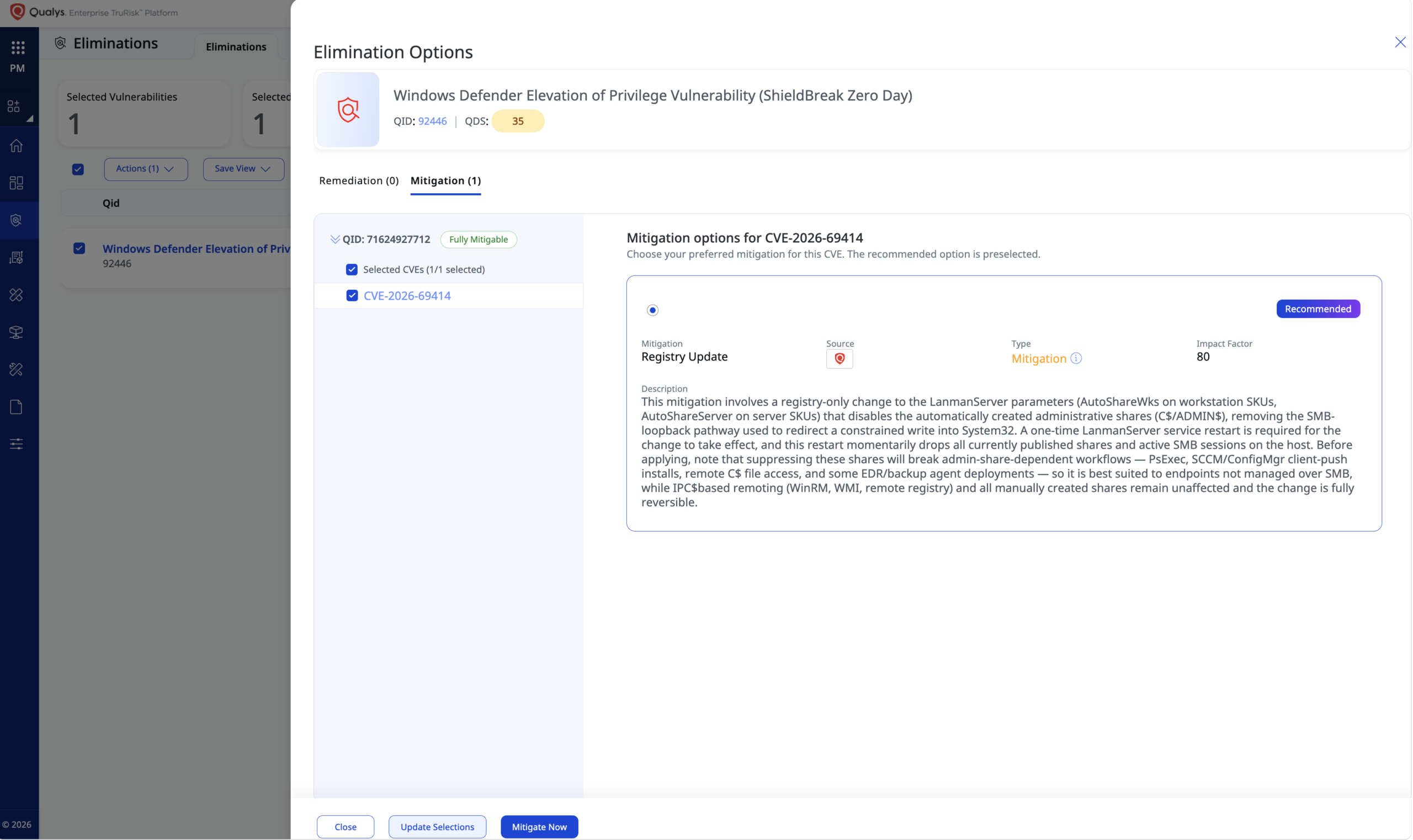
Qualys TruRisk™ Eliminate provides a recommended mitigation for CVE-2026-69414, giving security teams a way to close the gap while Microsoft works on a fix. Once applied, affected systems can be reassessed in Qualys VMDR to verify the remediation outcome.
Bottom Line
ShieldBreak leaves a real gap: a public PoC exists, SYSTEM-level compromise is possible, and Microsoft’s patch isn’t ready yet. Qualys VMDR provides visibility into which assets are affected, and TruRisk Eliminate lets you close the gap now rather than waiting for Microsoft’s timeline.
Note: Vendor patches may not be available for all vulnerabilities. TruRisk Eliminate is the Remediation Intelligence platform that provides both vendor patch deployment and patchless remediation capabilities. Patchless remediation is available exclusively to TruRisk Eliminate customers and is not included with Legacy Patch Management or VMDR. Request a trial today to experience TruRisk Eliminate.
Don’t wait for the patch. Start your TruRisk Eliminate trial and apply the ShieldBreak mitigation today.
Frequently Asked Questions (FAQs)
What is ShieldBreak (CVE-2026-69414)?
ShieldBreak is an elevation-of-privilege vulnerability in the Microsoft Malware Protection Engine used by Microsoft Defender. It allows a low-privileged local attacker to escalate to SYSTEM.
Is there a patch available for ShieldBreak?
No. Microsoft assigned CVE-2026-69414 on August 14, 2026, and is developing a security update; no patch is available yet.
How does ShieldBreak work?
ShieldBreak targets how Microsoft Defender processes files during cloud-file hydration. It uses a user-mode callback to interfere with the file data that Defender receives through the Cloud Filter API (CFAPI), along with Windows filesystem and Object Manager mechanisms, to influence which files Defender ultimately scans, thereby turning that privileged operation into code execution as NT AUTHORITY\SYSTEM.
Which systems are affected?
The public PoC was reported to work on Windows 11 25H2 and Windows Server 2025.
How can I detect ShieldBreak in my environment?
Qualys VMDR provides detection and visibility for CVE-2026-69414 (ShieldBreak) across your Windows environment via a QQL query that surfaces all affected assets.
What can I do before Microsoft releases a patch?
Qualys TruRisk™ Eliminate provides a recommended mitigation for CVE-2026-69414 that can be applied to affected systems while Microsoft works on a fix. Assets can then be reassessed in Qualys VMDR to verify the remediation outcome.