

TruConfidence: Why Your Patch Automation Can Finally Be Autonomous

TruConfidence: The AI-Powered Remediation Intelligence & Orchestration engine powering TruRisk Eliminate 2.0 delivers autonomous remediation at scale with proof at every step.
Executive Summary
Vulnerabilities are now discovered faster than enterprises can remediate them. Patch automation has been around for years, but vulnerability backlogs are still growing. Automation isn’t the bottleneck. Confidence is: without evidence of how a change will behave, Security and IT teams hold back, and the backlog grows. TruRisk Eliminate 2.0, the Autonomous RemOps platform, closes that confidence gap. TruConfidence, its remediation and orchestration intelligence engine, determines the safest, most effective way to eliminate each validated exposure while Agent Sara, Qualys’ risk remediation AI agent, executes these plans in customer-defined waves and progressive rings. Scanner-based remediation reaches edge and perimeter devices with the same Qualys scanners. Every change is monitored for operational health, rolled back automatically if anomalies arise, and closed with evidence. This approach enables rapid remediation without risking business continuity. In the past year, Qualys has deployed 178 million patches, with 40 million fully autonomous and a rollback rate under 0.1%.
Patch automation has existed for years. Yet in most enterprises, automated remediation jobs still wait in line behind change approvals and maintenance windows while critical exposures stay open.
The reason is that risk cuts both ways. Leave a vulnerability unpatched, and you invite exploitation. Push a faulty update, and you risk failed installs, rollbacks, or outages. Without evidence of how a change will behave, Security and IT teams default to caution, and the backlog grows.
Patch automation was never the blocker. Confidence is.

See TruConfidence in action
Join us for our upcoming webinar on November 4, 2026, 9:00 AM PT, to see how proactive security leaders are bridging the execution gap, featuring an exclusive first look at TruRisk Eliminate 2.0 and TruConfidence in action.
Today, we’re closing this gap with TruRisk Eliminate 2.0, the Autonomous RemOps platform. Powered by TruConfidence, its AI-powered Remediation and Orchestration Intelligence engine, and Agent Sara, Qualys’ autonomous AI agent for risk remediation, TruRisk Eliminate determines the right remediation action and executes it across your entire attack surface while keeping operations resilient.
The Confidence Gap: Why the Remediation Backlog Keeps Growing
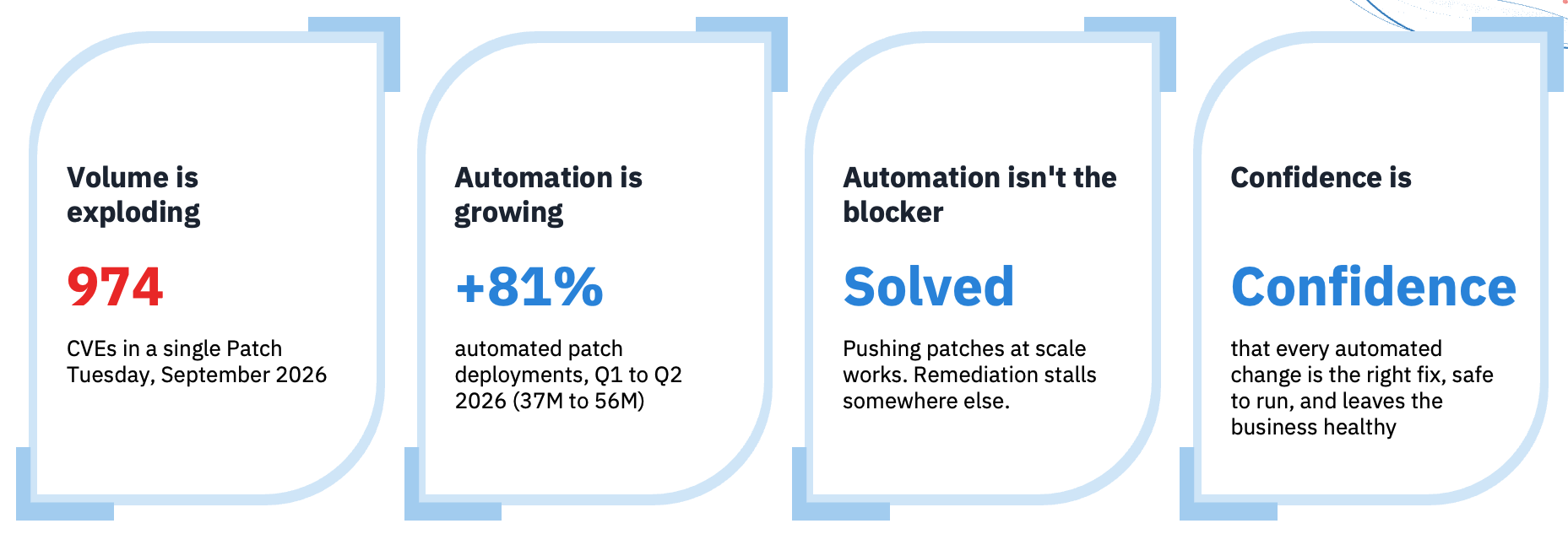
AI-powered discovery is finding vulnerabilities faster than ticket-driven remediation can close them. Patch Tuesday recently hit 974 CVEs in a single month, on a process built for about 100. Attackers are taking advantage. The Verizon 2026 DBIR found that 31% of breaches began with the exploitation of vulnerabilities, up from 20%, making it the top initial access vector.
Remediation has not kept pace. The same report shows the median time to remediate a known exploited vulnerability (KEV) rose from 32 to 43 days, and only 26% of KEVs are fully remediated. Qualys research shows the same widening gap between the speed of threats and the speed of remediation.
The ability to automate is not the constraint. Qualys customers already automate remediation at scale: automated patch deployments rose 81% between the first and second quarters of 2026. They can because Qualys gives them the evidence to trust each change, from which exposures matter to how reliably a patch will deploy. What stalls machine-speed remediation is the lack of evidence needed to confidently move beyond manual, human-led remediation workflows. Without that, automated or autonomous remediation stalls.
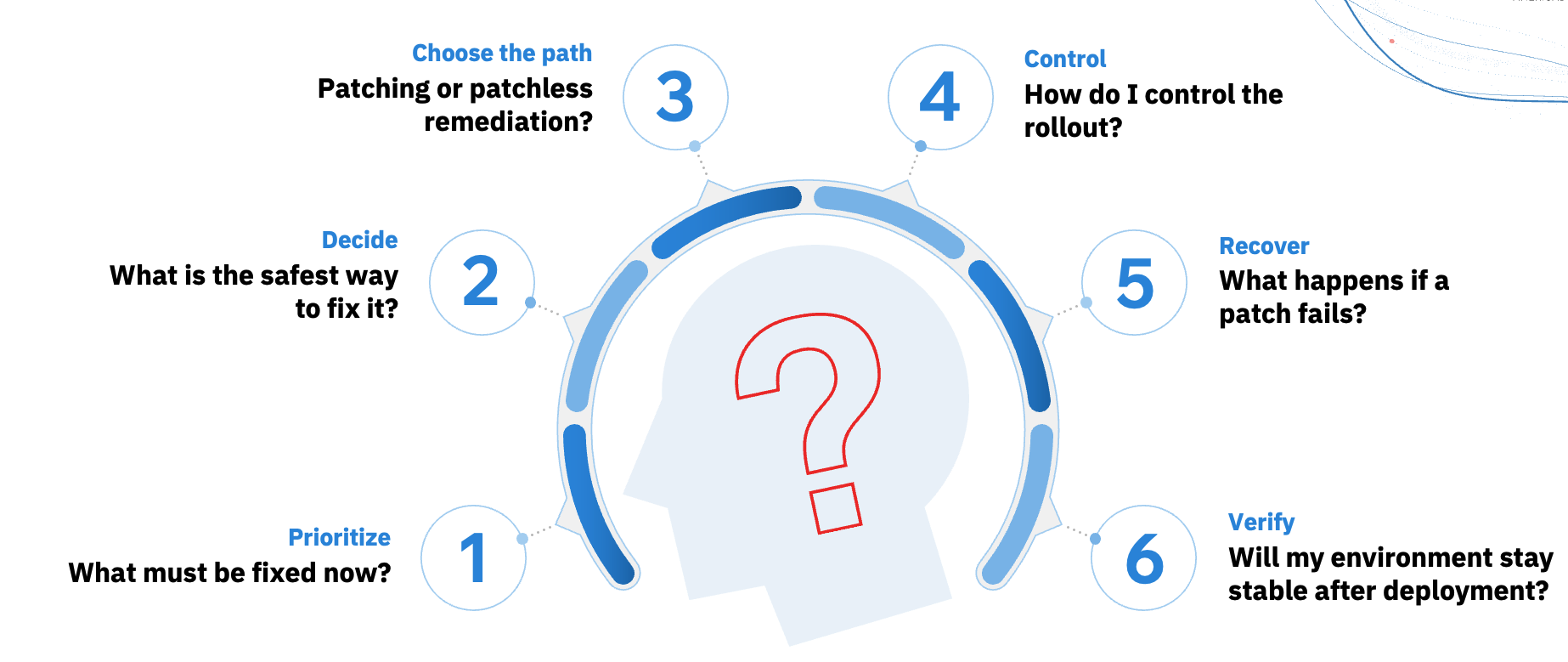
Before letting autonomous remediation run, Security and IT teams need answers to these questions:
- What must be fixed? Only 1% of vulnerabilities are exploited in the wild. Teams need to fix the validated exposures first, then tackle the long tail.
- Does it need a patch? Not every exposure needs one. A mitigation, an uninstall or an existing security control can close it faster, with less disruption.
- If it needs a patch, will it work and can it be automated? Teams need to predict whether a patch is safe to deploy and will not cause any business disruption, then roll it out progressively.
- How do we control the rollout? Teams need to deploy changes progressively: zero-touch automation for high-reliability patches on low-impact applications, and ring-based deployment for everything else.
- Did the environment stay healthy? Teams need ensure that risk was eliminated to maintain operational resiliency.
Answer these four questions with evidence, and remediation can run at machine speed without putting business continuity at risk.
How it Fits in the Autonomous RemOps Cycle
Closing that gap takes more than a better patch tool. It takes a new operating model for remediation: Autonomous RemOps.
Traditional patch tools push what is in the catalog and stop at “deployed.” Autonomous RemOps replaces that ticket-driven process with a continuous, evidence-based Decide → Execute → Prove. It determines what to fix, executes the appropriate remediation path across the entire attack surface, and demonstrates that the business remained resilient.
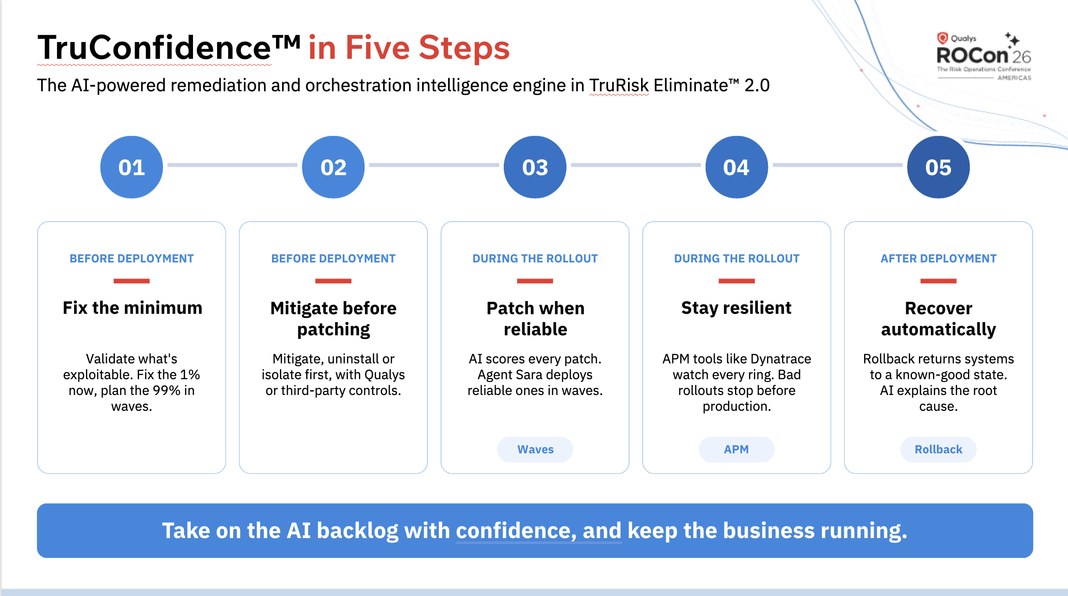
TruRisk Eliminate 2.0 runs that cycle in five steps. First, Qualys ETM and Agent Val validate what must be fixed. Second, TruConfirm credits the controls already in place. TruConfidence powers the final three steps, where autonomy carries the most operational risk: choosing the remediation path, controlling the rollout, and proving that it held.
Meet TruConfidence: Remediation Intelligence You Can Trust
TruConfidence is the remediation and orchestration intelligence layer behind TruRisk Eliminate. For every exposure, it answers one question: what is the safest and most effective way to eliminate this risk? Agent Sara puts that answer to work through waves. Together, they cover the full remediation lifecycle before, during, and after every deployment.
TruConfidence Before the Deployment
Once Qualys ETM and Agent Val have validated which exposures are exploitable and TruConfirm has credited the controls already in place, TruConfidence determines the right remediation path for each exposure.
Then you can determine whether a patch is needed at all. Patchless Remediation closes exposures by mitigating, uninstalling unused software, running a custom script or isolating the host. Third-Party Mitigation Intelligence extends those options through the tools teams already run, such as Zscaler and CrowdStrike.
When a patch is the right remediation action, the AI-Powered Patch Reliability Scoring predicts whether the patch is safe to deploy before it runs, drawing on global telemetry and Qualys customer deployments.
TruConfidence During the Rollout
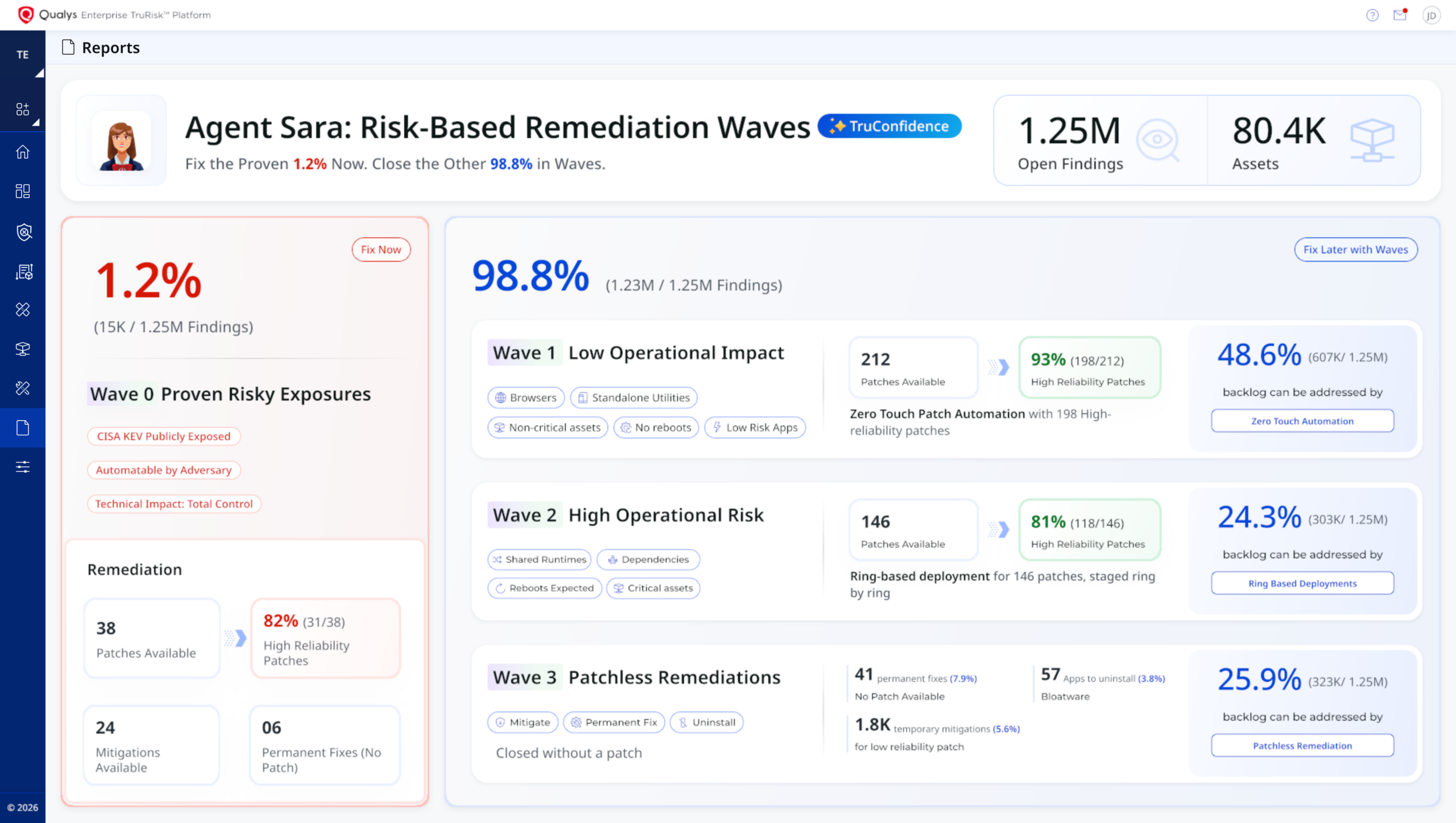
Agent Sara efficiently implements TruConfidence’s decisions, eliminating ticket queues. She prioritizes eliminating the exploited 1% first and then automatically addresses the remaining vulnerabilities.
She organizes the backlog into remediation waves; each matched to its level of risk. You define the waves to fit your environment, and Agent Sara runs them.
A typical setup might look like this:
- Easy Fixes: High-reliability patches on low-impact assets deploy zero-touch.
- Connectivity-Sensitive: Changes are sequenced carefully to protect systems with critical network dependencies.
- Operational Risk: Changes are held for closer review before proceeding.
- Beyond Patching: Exposures are routed to the patchless path TruConfidence selected.
Every change moves through progressive rings, from Pilot to broad deployment, and is observed before it reaches the next tier. A low-reliability signal automatically pauses progression, keeping the blast radius as small as possible.
Agent Sara works within your rules, not around them, enforcing maintenance windows, asset groupings, and rollback controls, and requires human approval wherever a critical service, identity infrastructure, or production databases are involved.
TruConfidence After the Rollout
A successful install is not the finish line. Operational Resiliency continues to correlate health signals after each change, monitoring for CPU spikes, memory issues, and service impact. Stable metrics confirm the change held, while anomalies pause the rollout and trigger rollback. When a remediation fails, AI-Powered Failure Analysis explains the root cause in plain language, such as a pending reboot or a missing prerequisite, and recommends the corrective action. Every change ends with evidence, which means faster recovery and fewer war rooms.
Request Now
Get your free Risk Elimination Playbook, powered by TruConfidence.
Remediation that reaches every corner of your attack surface
TruRisk Eliminate 2.0 goes past agent-based endpoints. It extends remediation to perimeter devices, cloud and applications, so teams can deal with an exposure wherever it lives. Each asset gets the response that fits it: patch it, mitigate the risk when no patch exists yet, uninstall the vulnerable software, isolate the asset or apply a custom fix.
For assets that can’t host an agent, Eliminate works through Qualys scanners and the security and IT integrations you already have. Every exposure gets a path to remediation, not just the ones on managed endpoints.
Proven in Production. Built to Keep Going
TruRisk Eliminate already runs remediation at scale:
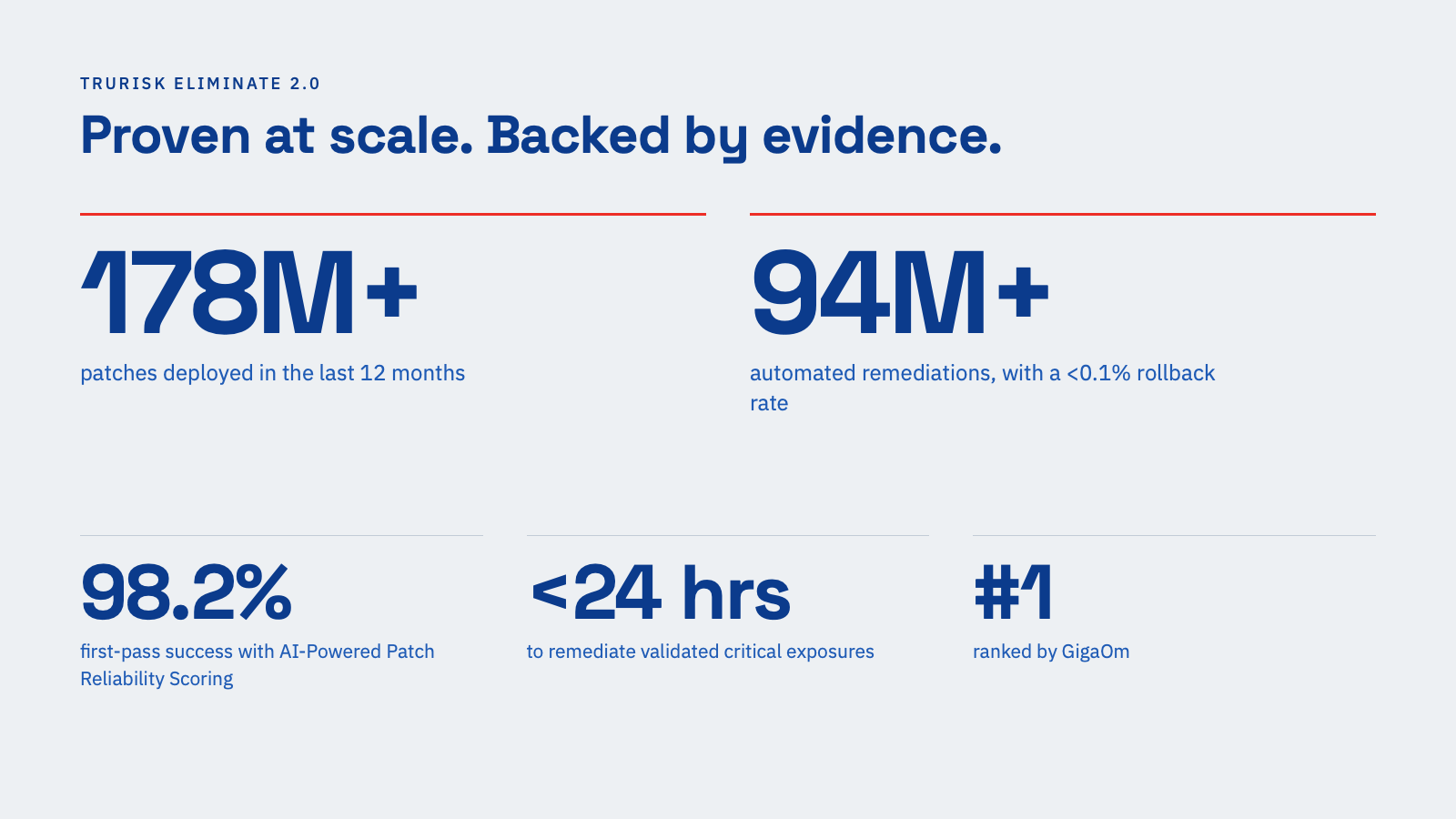
Each pass through the cycle first closes validated exposures and moves the long tail into the next waves, so the backlog shrinks continuously rather than piling up between change windows. And because every change is backed by proof, TruRisk Eliminate becomes both the system of record and the system of action for cyber risk reduction.
Give your board confidence in security and business continuity.
Start a TruConfidence trial and watch TruRisk Eliminate 2.0 decide, execute, and prove remediation in your own environment.