

FedRAMP Authorization Is the Easy Part: How to Stay Authorized with Qualys Policy Audit

Key Takeaways
- FedRAMP authorization isn’t the finish line. Providers are expected to keep monitoring their security posture and give federal agencies the information they need for ongoing, risk-based decisions.
- CISA’s BOD 26-04, issued on June 10, 2026, moves federal vulnerability management toward risk-based prioritization instead of a single fixed deadline for every finding.
- FedRAMP has said the legacy monthly scan is no longer sufficient. Its new Vulnerability Detection and Response (VDR) and Vulnerability Evaluation and Reporting (VER) rules become mandatory for certification on December 7, 2026.
- In PwC’s 2025 Global Compliance Survey, 85% of executives said compliance requirements have grown more complex over the last three years.
- Qualys Policy Audit supports a continuous assess, prioritize, remediate, and report workflow. Audit Fix automates remediation, and control mapping lets one validated control count across multiple frameworks.
Ask anyone who has taken a cloud service through the Federal Risk and Authorization Management Program (FedRAMP) what the process feels like, and you’ll hear roughly the same story. Months of control documentation, a System Security Plan running hundreds of pages, a Third-Party Assessment Organization (3PAO) assessment that turns up gaps nobody saw coming, and finally an Authority to Operate (ATO) letter. What that story usually leaves out is that the letter isn’t the finish line. It’s where the real work starts.
Once a Cloud Service Offering is authorized, FedRAMP expects the provider to continue monitoring its security posture and keep feeding federal agencies the information they need to make ongoing, risk-based decisions. On June 10, 2026, the Cybersecurity and Infrastructure Security Agency (CISA) raised that bar again with Binding Operational Directive (BOD) 26-04, and FedRAMP moved fast to bring its own rules with it.
The takeaway is fairly simple. Getting authorized was never the hard part. Proving, day after day, that your controls are still doing what they’re supposed to do is the hard part, and it’s the problem policy audit automation exists to solve.
Getting FedRAMP authorized is step one. Learn how to stay authorized.
Why Point-in-Time Compliance Stopped Working
FedRAMP used to run on a predictable cadence. Assess, authorize, submit monthly scans, repeat. That model has been cracking for a while now, and three things are driving it.
- Vulnerability doesn’t just mean a Common Vulnerabilities and Exposures (CVE) entry anymore. Misconfigurations and control drift are squarely in scope now, so a clean scan can still be hiding a compliance failure.
- Environments move faster than assessment cycles do. Cloud-native infrastructure can drift a dozen times a week, while monitoring reports still tend to go out monthly or quarterly.
- Regulators have stopped accepting “we’ll catch it at the next audit.” Federal risk management is moving away from calendar-based reviews and toward real-time, exposure-based decisions.
CISA BOD 26-04, in Plain Terms
BOD 26-04, issued by CISA in June 2026, moved federal vulnerability expectations toward continuous, risk-based validation instead of a single fixed deadline applied to every finding. FedRAMP responded within days, confirming that the legacy monthly scan most Rev5 Cloud Service Providers (CSPs) still lean on for their compliance evidence isn’t going to hold up anymore, and setting December 7, 2026, as the date its new Vulnerability Detection and Response and Vulnerability Evaluation and Reporting rules become mandatory for certification. For compliance and audit teams, the practical read is simple. The evidence you hand to an assessor has to reflect what’s true right now, not what was true at the last scan.
The Pain Points Teams Keep Naming
Talk to FedRAMP compliance teams, and the same challenges come up again and again:
- Finding control gaps before an assessor does, instead of during the assessment window
- Keeping configurations from drifting after they were compliant on day one
- Prioritizing remediation when continuous assessment produces a continuous stream of findings
- Providing continuous visibility instead of handing over a report generated the week before an audit
- Producing audit-ready evidence on demand instead of assembling it after the fact
- Cutting duplicate effort across overlapping frameworks, since most FedRAMP teams are also carrying National Institute of Standards and Technology (NIST) 800-53, Cybersecurity Maturity Model Certification (CMMC), Payment Card Industry Data Security Standard (PCI DSS), and increasingly the Digital Operational Resilience Act (DORA) on the same infrastructure
In PwC’s 2025 Global Compliance Survey of 1,802 executives across 63 territories, 85% said compliance requirements have grown more complex over the last three years, and nearly 90% said the breadth of their compliance responsibilities has expanded over that same period. That pressure adds cost and strains the teams that have to prove compliance. Misconfigurations make it worse: Qualys analysis of more than 1 billion misconfiguration findings shows access control failures account for 38% of exposures, and organizations take an average of 14 months to fix these basic gaps.
None of this is a documentation problem. It’s an automation problem that’s been wearing a documentation costume.
How Policy Audit Solves the Problem
This is where a continuous assess, prioritize, remediate report workflow stops being a slide in a deck and starts being how the work actually gets done.
On the assessment side, instead of a monthly scan, Qualys Policy Audit continuously evaluates technical controls against the FedRAMP baseline, mapping each policy to a technical check, an expected value, and a pass or fail result across every system in scope. That’s the difference between documenting a control on paper and being able to prove it’s still operating the way it was the day you got your ATO.
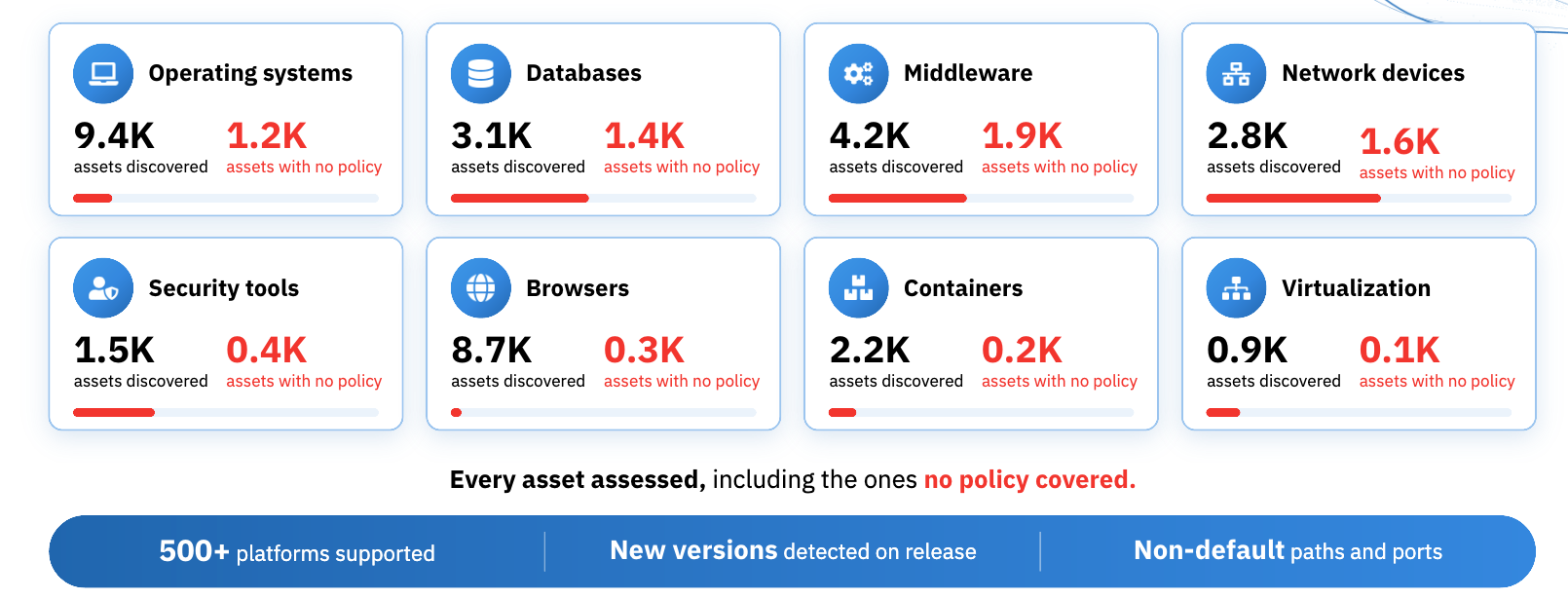
Qualys lays this out as five practical steps rather than a single feature:
- Connect findings to the control context. Connect raw findings to the control and framework context instead of handing teams a pile of technical output to interpret on their own.
- Prioritize what impacts audit outcomes. This is where the volume problem gets solved. Research behind the approach found that fewer than 1% of vulnerabilities in a typical environment pose the highest risk or genuinely need immediate action to move audit outcomes, so results get filtered by control criticality, asset scope, internet-facing devices, the Known Exploited Vulnerabilities (KEV) Catalog, and risk signals like MITRE ATT&CK mappings, not just counted.
- Automate remediation. Remediation is where the old workflow falls apart. Flag a finding, file a ticket, wait, hope someone remembers to re-scan. That process was never fast, and BOD 26-04’s tighter windows make it untenable. Audit Fix closes the loop instead, automating the fix itself and applying it consistently across assets rather than leaving it to a ticket queue.
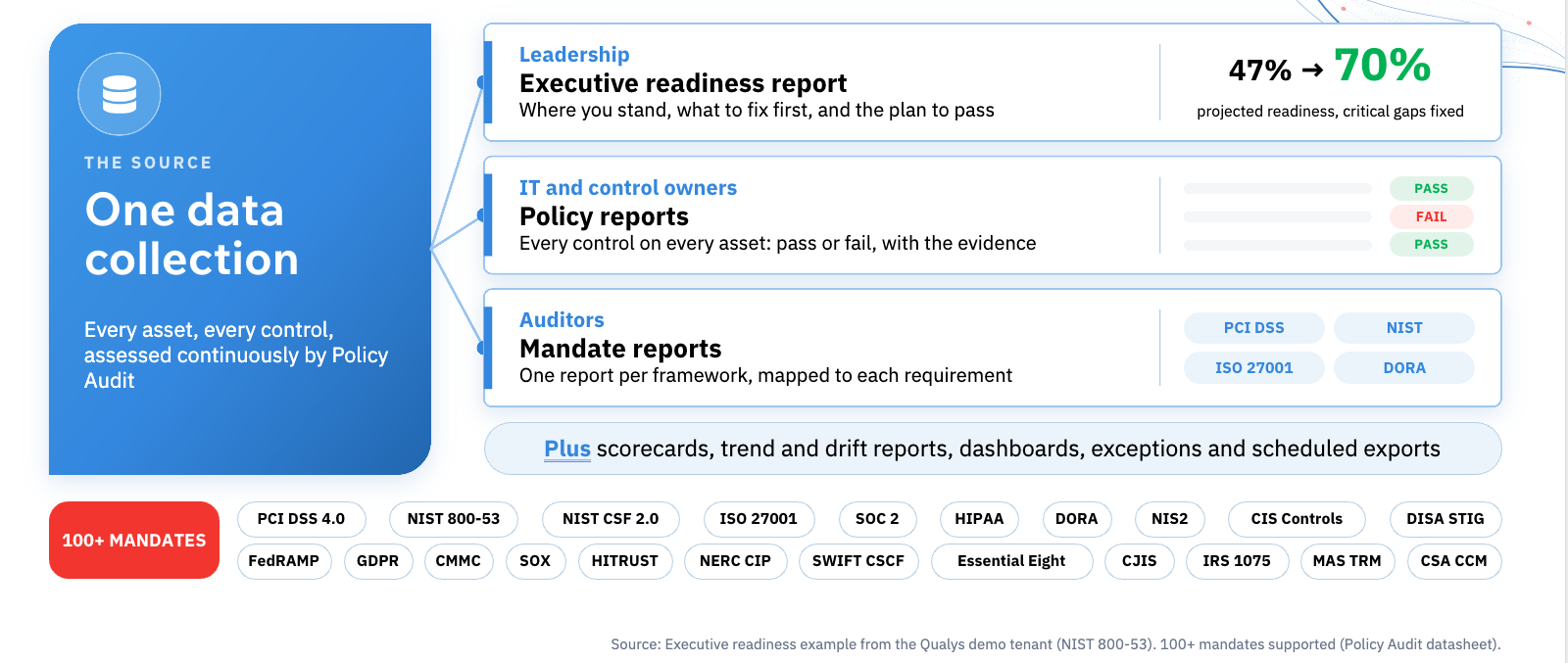
- Map controls across frameworks. A control validated once, whether that’s for FedRAMP, System and Organization Controls (SOC) 2, ISO 27001, General Data Protection Regulation (GDPR), or something else, counts toward every other framework it maps to as well, so teams stop re-proving the same control for every audit that comes around.
- Shift to continuous audit readiness. Audit outcomes should reflect the current state of the environment, not a snapshot from whenever someone last pulled a report. That’s the same point CISA and FedRAMP are making.
For a closer look at each step, read 5 Steps to Turn Compliance Checks into Audit Outcomes.
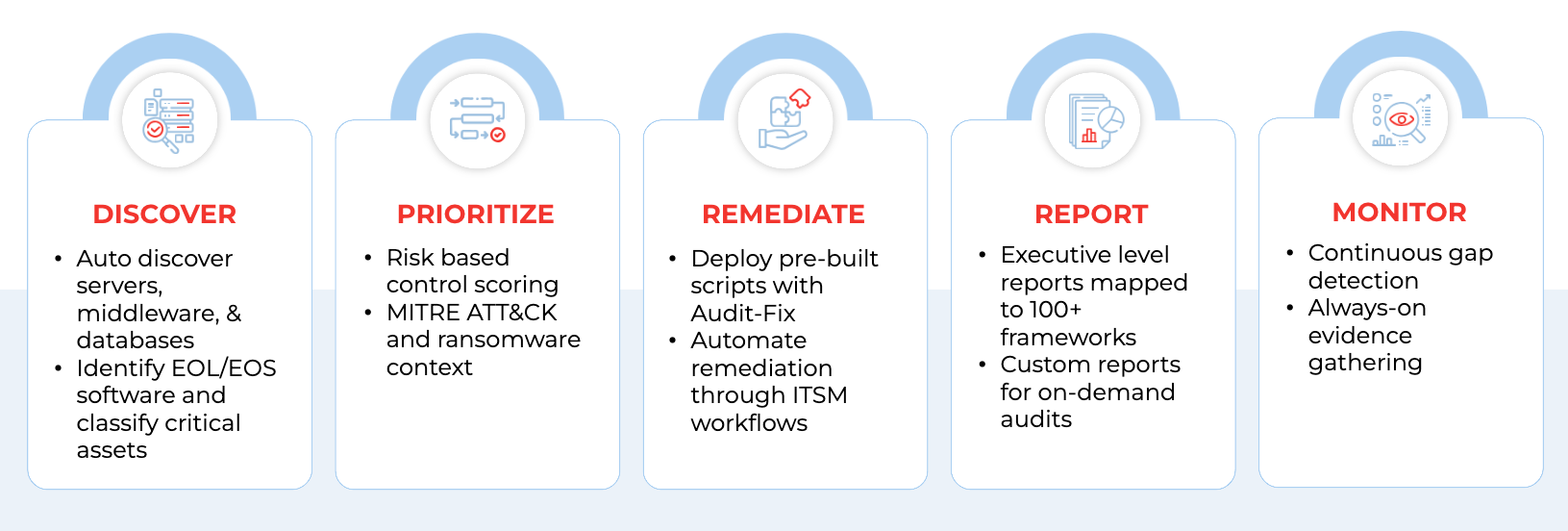
Qualys Policy Audit doesn’t replace governance, training, or personnel security. Those stay organizational, and a configuration scanner can’t assess them. On the technical side, it assesses your systems against NIST 800-53 controls in families such as:
- Configuration management (CM): settings checked against baselines, with drift flagged
- System and information integrity (SI): integrity protections and file changes
- Audit and accountability (AU): logging and audit settings
- Risk assessment (RA): gaps ranked by risk, not just counted
- Assessment, authorization, and monitoring (CA): continuous monitoring of control status
That’s not a coincidence. It’s the reason this category of tooling exists in the first place.
The Takeaway
FedRAMP compliance isn’t a project with an end date anymore. It’s an ongoing discipline, and the rules keep tightening. Teams that still treat authorization as the finish line keep getting caught off guard at reassessment. The teams staying ahead of directives like BOD 26-04, rather than scrambling to react to them, are the ones who’ve built assessing, prioritizing, remediating, and reporting into how they run compliance day-to-day, not just how they prepare for an audit.
If you want to see what that looks like, watch our on-demand webinar, “FedRAMP Authorization and What It Now Takes to Keep It.” It features Kaleb Knobel, Senior Security Analyst and Information System Security Officer (ISSO), and Anu Kapil, Director of Product Management. They share how Policy Audit helps organizations continuously assess, prioritize, remediate, and report on FedRAMP readiness, plus what FedRAMP Moderate and High teams should be doing right now.
See what FedRAMP Moderate and High teams should be doing right now.
Frequently Asked Questions (FAQs)
Why isn’t FedRAMP authorization the finish line?
After authorization, FedRAMP expects providers to keep monitoring their security posture and give agencies the information they need for ongoing, risk-based decisions. Proving that controls still work, day after day, is the harder part.
What is CISA BOD 26-04?
It’s a Binding Operational Directive that CISA issued on June 10, 2026. It prioritizes vulnerability remediation by risk factors such as public exposure, Known Exploited Vulnerabilities (KEV) status, automatability, and technical impact, instead of applying one fixed deadline to every finding.
How did FedRAMP respond to BOD 26-04?
Within days, FedRAMP said the legacy monthly scanning that most Rev5 services rely on is insufficient. It set December 7, 2026, as the date its new VDR and VER rules become mandatory for certification. Under these rules, providers must evaluate whether each vulnerability is reachable from the internet and likely to be exploited, fix KEVs within BOD 26-04 timelines, and keep responding to vulnerabilities on an ongoing basis.
How does Qualys Policy Audit support FedRAMP compliance?
Policy Audit continuously evaluates technical controls against the FedRAMP baseline. It maps each policy to a technical check, an expected value, and a pass or fail result so that teams can prioritize, remediate, and report on gaps between audits.
Does Policy Audit replace governance or training?
No. Governance, training, and personnel security remain organizational responsibilities. Policy Audit focuses on technical controls.