

NGINX2Root: Five nginx Flaws, Led by CVE-2026-123007. How to Find, Mitigate, and Patch Now

Executive Summary
NGINX2Root is a set of five nginx vulnerabilities disclosed on November 18, 2026. The lead flaw, CVE-2026-123007, is a memory corruption bug in the way nginx handles HTTP/2 connections. F5, which maintains nginx, rates it 9.2 under CVSS v4.0 and 8.1 under CVSS v3.1. An attacker with no credentials can crash nginx worker processes, and researchers have demonstrated remote code execution with the privileges of the nginx worker. Where the worker runs without root privileges, an attacker would need an additional escalation path to gain root. This could involve chaining the NGINX vulnerability with a suitable local privilege-escalation flaw. Unpatched builds of NGINX Open Source from 1.9.5 through 1.31.8, and unpatched NGINX Plus builds, are in scope when HTTP/2 is enabled. Fixes shipped in NGINX Open Source 1.30.7 and 1.31.9, and turning off HTTP/2 closes this exposure where patching has to wait. A separate Linux kernel flaw that the researchers used to go from the worker account to root has no patch yet. Start with internet-facing nginx servers that accept HTTP/2, and assign an owner and a deadline to every system still unpatched.
What’s at Risk
A Flaw in nginx Could Hand Attackers the Front Door to Your Applications. nginx is often the first system a web request reaches. It runs as a web server, a reverse proxy (a server that passes requests to the applications behind it), a load balancer, and the entry point to Kubernetes clusters. CVE-2026-123007 is in nginx’s own HTTP/2 code, so no application behind it has to be at fault.
HTTP/2 lets a client tell the server how much data it is allowed to send. nginx can lose count of that allowance when a client cancels requests at the right moment. The bad count later makes nginx copy memory it should not touch.
F5 says the result is typically a crash of the nginx worker, the process that handles live traffic. F5 also says code execution is possible where ASLR, the memory-address randomization that makes exploits harder, is disabled or bypassed. Xint, the team that named NGINX2Root, reports doing exactly that: it leaked memory addresses and then ran commands as the nginx worker over a public HTTPS port.
In Qualys TRU’s assessment, three outcomes matter to the business:
- Exposure of traffic and keys. Code running in the worker can read requests and responses after nginx decrypts them, including passwords and session tokens. It may also expose TLS private keys that are held in software and accessible to the worker.
- A foothold behind the perimeter. Backend systems usually trust the proxy in front of them. An attacker on that proxy starts from a trusted position.
- Outages. A failed attempt can still crash workers and drop connections.
Workers normally run under a restricted account. An attacker gets whatever privileges the worker actually has, so if it already runs as root, no further escalation is needed in that environment. Where it does not, the researchers chained a separate flaw in the Linux kernel’s SCTP code to get root. SCTP is a network protocol, like TCP, that the kernel supports. They report root on the host, including from nginx running inside a Docker container. That kernel flaw has no CVE and no patch yet, so patching nginx removes the remote entry point but not the step to root.
NGINX2Root covers four more nginx flaws. F5 scores all five 9.2 under CVSS v4.0 and 8.1 under CVSS v3.1, and the same nginx releases fix them. Each needs a different configuration:
| CVE | CONFIGURATION THAT PUTS A SERVER IN SCOPE | DOES TURNING OFF HTTP/2 HELP? |
| CVE-2026-123007 | HTTP/2 enabled | Yes |
| CVE-2026-123633 | HTTP/2 for clients, requests passed to a backend, and a worker running low on connections | Yes |
| CVE-2026-123634 | Proxying where the backend server name contains variables, plus an SSI or mirror subrequest that looks up the same name | No |
| CVE-2026-121810 | HTTP/3 enabled | No |
| CVE-2026-113425 | nginx used as a mail proxy | No |
The rest of this post focuses on CVE-2026-123007, the flaw with the widest reach.
Why NGINX2Root Is Also an Application Security Problem
NGINX2Root is an infrastructure flaw, but its impact lands on the applications behind nginx. Where nginx terminates TLS and proxies requests, every login, API call, and session cookie bound for those applications passes through the worker process in clear text. An attacker running code in that worker sits between users and the applications they trust:
- Credentials and tokens become reusable. Passwords, session cookies, API keys, and bearer tokens read from the worker can be replayed directly against the applications and APIs behind the proxy, where they look like legitimate user traffic.
- Trust placed in the proxy becomes the attacker’s. Backend services, internal APIs, and admin interfaces are often reachable only from the proxy. Applications that accept identity or client details from headers the proxy sets, such as X-Forwarded-For or user headers added after single sign-on, trust whatever the compromised proxy sends.
- Application traffic can be altered in transit. Requests and responses pass through the worker, so the attacker is positioned to change what users receive and what the backend processes, with no change to application code.
- One proxy, many applications. A shared reverse proxy or Kubernetes ingress controller often fronts dozens of applications owned by different teams. A worker crash takes all of them offline at once.
For application security teams, the scoping question is not only which hosts run a vulnerable nginx build, but which applications and APIs depend on them, what data those applications handle, and who owns them.
Are You Affected?
A system is in scope only when both conditions are true. For an attack to work, the attacker must also be able to open an HTTP/2 connection to nginx itself.
| CONDITION | AFFECTED | NOT AFFECTED |
| NGINX BUILD | Unpatched NGINX Open Source 1.9.5 through 1.31.8. Unpatched NGINX Plus: 37.0.0 before 37.0.8.1, 37.1.0 before 37.3.0.1, and R33 and later R-series releases | NGINX Open Source 1.30.7 and 1.31.9. Releases before 1.9.5, which predate HTTP/2 support. Builds compiled without the HTTP/2 module. Any vendor build that contains the fix |
| HTTP/2 | Turned on for at least one listener, with http2 on; or with http2 on a listen line | Not turned on for any listener |
F5 notes that it did not evaluate versions past End of Technical Support. F5 also lists BIG-IP, BIG-IQ, and F5OS as not vulnerable in its advisory.
The checks below come from the researchers’ write-up. Run them on the nginx host. The first shows whether the build includes HTTP/2. The second shows whether the configuration turns it on.
nginx -V 2>&1 | grep -o — ‘–with-http_v2_module’
sudo nginx -T 2>&1 | sed ‘s/#.*//’ | grep -nE ‘listen[[:space:]].*http2|^[[:space:]]*http2[[:space:]]+on[[:space:]]*;’
Run this one from outside your network. ALPN protocol: h2 means the server accepts HTTP/2 from the internet.
openssl s_client -connect HOST:443 -servername HOST -alpn h2 </dev/null 2>&1 | grep -E ‘ALPN protocol:|No ALPN negotiated’
nginx also ships inside other software. Status as of November 18, 2026:
| WHERE NGINX RUNS | STATUS |
| F5 NGINX INGRESS CONTROLLER | Release 5.8.0 builds on NGINX Open Source 1.31.9. For NGINX Plus images, confirm the build against F5’s advisory |
| F5 NGINX GATEWAY FABRIC | Release 2.9.0 moves to NGINX Open Source 1.31.9. For NGINX Plus images, confirm the build against F5’s advisory |
| COMMUNITY INGRESS-NGINXFOR KUBERNETES | Archived in March 2026. The project states it will ship no further security fixes |
| LINUX DISTRIBUTION PACKAGES | Ubuntu and Debian list their nginx packages as vulnerable, with no fixed package yet |
| OFFICIAL DOCKER IMAGE | Mainline tags now point to 1.31.9. Running containers stay on the old build until you pull and redeploy |
| OTHER PRODUCTS THAT BUNDLE NGINX | Potentially affected. Verify the bundled nginx version, vendor backports, and whether the vulnerable feature is enabled |
Three cautions when scoping:
- Do not rely on nginx -v alone. Distributions often fix a flaw without changing the nginx version number. Compare the full package version with the distribution’s advisory.
- Check where the HTTP/2 connection ends. If a CDN or load balancer handles HTTP/2 in front of nginx, an outside test only reaches that device. Test the nginx port directly.
- Use internet exposure to order the work, not to close findings. An internal nginx with HTTP/2 on is still reachable by an attacker who is already inside the network.
Exploitation Status
As of November 18, 2026, we have not seen public confirmation of exploitation in the wild.
Working exploit code is public. The team behind NGINX2Root also reports its own exploit working over public IP addresses on AWS, GCP, and Azure, and is holding back the final steps.
The public exploit is hard to use. It sends a very large number of HTTP/2 control messages over one long-lived connection for several minutes, has to reach nginx directly, and depends on a specific memory-copy routine in the standard Linux C library on 64-bit Intel and AMD processors.
These limits slow mass exploitation. In Qualys TRU’s assessment, they do not protect a specific internet-facing server from a capable attacker, and other techniques may follow.
What to Do Now
Updating nginx is the only complete fix. F5 released fixed builds on November 18, 2026.
| PRODUCT | AFFECTED | FIXED BUILD |
| NGINX OPEN SOURCE, MAINLINE | 1.31.0 through 1.31.8 | 1.31.9 |
| NGINX OPEN SOURCE, STABLE | 1.30.0 through 1.30.6 | 1.30.7 |
| NGINX OPEN SOURCE, OLDER BRANCHES | 1.9.5 through 1.29.x | None listed. Move to 1.30.7 or 1.31.9, or use a vendor package that contains the fix |
| NGINX PLUS 37.1 AND LATER | 37.1.0 before 37.3.0.1 | 37.3.0.1 |
| NGINX PLUS 37.0 | 37.0.0 before 37.0.8.1 | 37.0.8.1 |
| NGINX PLUS R-SERIES | R34 through R36 in F5’s advisory, R33 and later in the CVE record | None listed. Move to a fixed 37.x build |
Linux distributions publish on their own schedules. As of November 18, 2026, Ubuntu and Debian had not shipped fixed packages. Use your vendor’s advisory to identify the fixed package and confirm it addresses CVE-2026-123007.
Restart nginx after you update. A reload applies configuration changes but keeps the old program running, so the flaw stays in memory until a restart.
If you cannot patch today, turn off HTTP/2 on every affected listener. F5 states the flaw affects only configurations that use HTTP/2, and the researchers recommend this as a temporary measure. For the exact steps, see nginx’s documentation for the http2 directive, CERT-EU’s advisory, and section 3.3 of the researchers’ write-up. Clients fall back to HTTP/1.1. Services that need HTTP/2, such as gRPC, will stop working, so test first. This covers CVE-2026-123007 and CVE-2026-123633 only, and it does not replace the patch.
Advice for Risk and Vulnerability Management Teams
Qualys TRU’s advice for the teams running this response:
- Do not let the score set the deadline: Under CVSS v3.1 this flaw is 8.1, which many remediation policies file as High. Public exploit code and a server that faces the internet matter more than the number. Handle vulnerable nginx deployments with externally reachable HTTP/2 as an emergency.
- Close findings on evidence: A server is done when the fixed build is installed, nginx has been restarted, and the vendor’s advisory confirms the package covers all five CVEs. Report patched, temporarily mitigated, not exposed by configuration, and unknown as separate states, and do not count unknown as safe.
- Fix the template as well as the server: Update container images, Helm charts, machine images, and autoscaling templates. Otherwise the next scale-out or failover brings the vulnerable build back.
- Map each nginx instance to the applications and APIs behind it. A host inventory shows where a vulnerable build is installed; it does not show which applications, owners, and data depend on it. Use that mapping to set priority and to notify application owners, not to close findings.
- Put an end date on every workaround: Turning off HTTP/2 covers two of the five flaws, and the next configuration push can undo it. Record who owns each exception and when it ends.
- Decide what to do with nginx that will not get a fix: The community ingress-nginx project is archived, and the older NGINX Plus R-series branches have no fixed build listed, although fixed NGINX Plus 37.x releases exist. These need a migration plan or a signed risk acceptance.
- Treat privilege escalation flaws as part of this response: Where the worker runs without root privileges, an attacker would need an additional escalation path to gain root. The newly disclosed SCTP flaw is one such path, and any other local privilege-escalation flaw that can be exploited from the worker’s context could serve the same purpose. Patch known local privilege-escalation flaws on nginx hosts, in the kernel and elsewhere, with the same urgency. A current kernel does not mean the SCTP flaw is fixed, because that flaw has no patch yet.
How Qualys Can Help
Inventory nginx Installations with Qualys CSAM
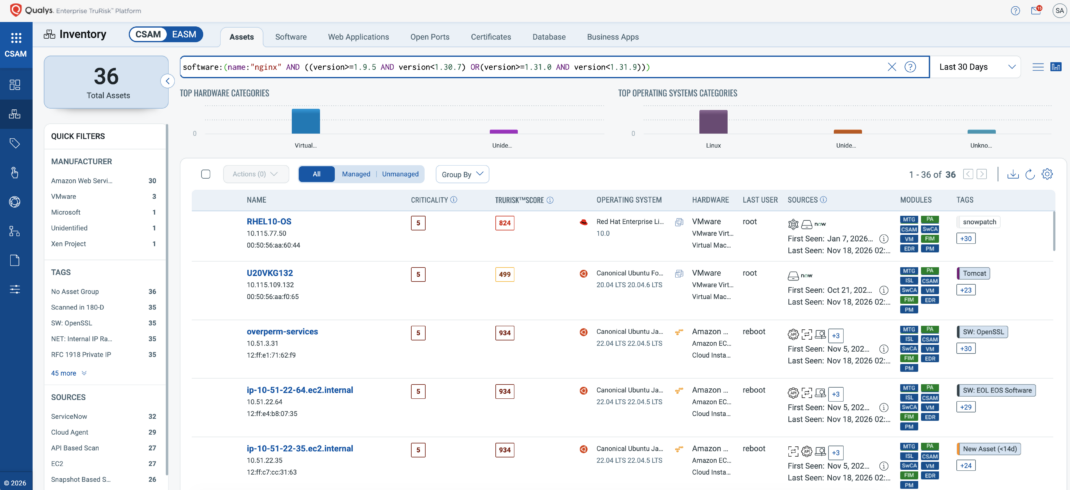
Qualys CyberSecurity Asset Management (CSAM) lists every asset with nginx installed, along with the version of each installation, so teams can quickly scope NGINX2Root remediation. Because NGINX Open Source 1.9.5 through 1.31.8 is affected, the version tells you which installations are in range. It does not tell you whether HTTP/2 is turned on or whether a Linux distribution has backported the fix, so check those separately. nginx bundled in containers, Kubernetes ingress controllers, and appliances may not appear in a standard inventory, so check those separately too.
Assets With nginx in the Affected Range
Use the following CSAM query to identify potentially affected NGINX Open Source installations on the stable, mainline, and older branches for further assessment. It uses two ranges because 1.31.0 through 1.31.8 are affected even though they are higher than the fixed 1.30.7.
software:(name:”nginx” AND ( (version>=1.9.5 AND version<1.30.7) OR (version>=1.31.0 AND version<1.31.9) ))
Detect NGINX2Root at Disclosure with Qualys InstaScan
NGINX2Root will not be patched everywhere at once. On November 18, F5 shipped NGINX Open Source 1.30.7 and 1.31.9, fixed NGINX Plus 37.x builds, and updated releases of NGINX Ingress Controller and NGINX Gateway Fabric, and the official Docker image now carries fixed tags. Older NGINX Plus R-series branches have no fixed build listed, and Ubuntu and Debian still list their stable nginx packages as vulnerable. n, powered by Agent Insta, keeps detection from waiting on any of those schedules. It checks every new vendor advisory against the software inventory Qualys already has for your assets, whether that inventory came from Qualys Cloud Agents, Qualys scanners, or third-party tools you have connected.
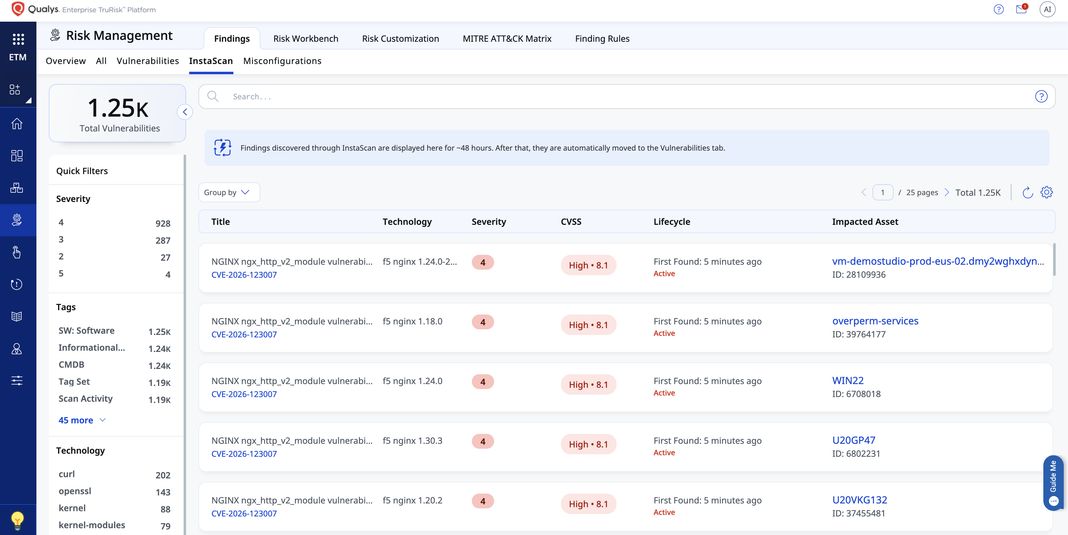
For assets in your InstaScan scope, vulnerable nginx installations show up as CVE-2026-123007 findings in Qualys ETM, typically within minutes of the advisory, with no scan to schedule. That gives your team owners and deadlines to work with before the VMDR detection QIDs below are released. Because InstaScan matches on the installed nginx version, it cannot see whether HTTP/2 is turned on or whether a distribution has backported the fix. Use the checks in Are You Affected? to decide which findings to work first, and close them only on the evidence described above.
Where to find InstaScan findings. CVE-2026-123007 findings land in Qualys ETM under Risk Management → Findings → InstaScan, a tab that holds only the last 48 hours or so of InstaScan detections. After that they move to the Vulnerabilities tab. When a Cloud Agent or scanner later detects the same CVE on the same asset, the two detections are merged into one record rather than duplicated. To pull InstaScan findings back up in the Vulnerabilities tab, search for finding.isInstaScan: TRUE, click the InstaScan summary card, or look for the InstaScan badge in the Sources column.
Identify Applications Potentially Impacted by NGINX2Root with Qualys TotalAppSec
CSAM and VMDR show where vulnerable nginx is installed. TotalAppSec answers the question application security teams need answered next: which web applications and APIs are served through it, and who owns them.
Discover the full application attack surface. TotalAppSec continuously discovers web applications and APIs across internet-facing and internal environments, on premises and in the cloud, including unknown, forgotten, shadow, and rogue applications. It builds a unified inventory by integrating with Qualys EASM and CSAM and with API sources such as Postman and MuleSoft.
Detect vulnerable nginx in front of your applications. TotalAppSec includes the following detections for the five NGINX2Root CVEs:
| QID | Detection Title | CVE |
| 520442 | Nginx Integer Underflow | CVE-2026-123007 |
| 520441 | Nginx Use After Free | CVE-2026-123633 |
| 520443 | Nginx Use After Free | CVE-2026-123634 |
| 520444 | Nginx Use After Free | CVE-2026-121810 |
| 520445 | Nginx Use After Free | CVE-2026-113425 |
| 520446 | Nginx Denial of Service | CVE-2026-118899 |
| 520447 | Nginx NULL Pointer Dereference | CVE-2026-120993 |
| 520448 | Nginx Integer Underflow | CVE-2026-125283 |
| 520449 | Nginx Insufficient Validation | CVE-2026-123640 |
| 520450 | Nginx Client Certificate Bypass | CVE-2026-120967 |
These QIDs are version-based: they report that the nginx version identified for the target application falls in an affected range. A detection marks an application for investigation