

How Federal Agencies Can Activate a Risk Operations Center (ROC) to Meet CISA BOD 26-04

Last updated on: August 21, 2026
Executive Summary
Recognizing the ability of Frontier AI models to discover and exploit vulnerabilities at unprecedented speed and scale, CISA’s Binding Operational Directive (BOD) 26-04 marks a significant shift in federal vulnerability management. The directive introduces aggressive mandates, requiring federal civilian agencies to remediate high-risk vulnerabilities, specifically those that are publicly exposed, on the KEV catalog, able to be automated, and grant full system control within a strict 3-day SLA, while making forensic triage mandatory before patching. Rather than prioritizing remediation based on patch availability, the directive requires agencies to focus on risk-informed, evidence-based decision-making, accounting for exploitability, exposure, and mission impact. This shift reflects a new operational reality: modern threats, accelerated by advances in AI, are compressing vulnerability exploitation timelines from weeks to hours. Traditional patch-centric models can no longer keep pace. To meet these requirements, agencies must move beyond siloed tools and linear workflows toward a continuous, integrated operating model. A Risk Operations Center (ROC) enables this transformation by unifying detection, prioritization, validation, and remediation into a closed loop focused on measurable risk reduction. Qualys VMDR, ETM, and TruRisk Eliminate, delivered via a unified risk management platform, will empower teams to achieve this goal in the most efficient way and keep the mission moving forward.

On June 10, 2026, CISA announced BOD 26-04, revising how federal agencies handle vulnerability management. This formally transitions federal agencies away from blanket patching strategies toward risk-based vulnerability management. Instead of treating all vulnerabilities equally, agencies must evaluate exposures based on:
- Internet exposure
- Known Exploited Vulnerabilities (KEV) alignment
- Real-world exploitability
- Asset criticality and mission impact
BOD 26-04 was shaped in direct response to the change to the threat landscape created by rapidly evolving AI models, advanced systems now capable of identifying and exploiting software vulnerabilities at speeds that leave traditional patch cycles far behind. This approach acknowledges another key reality, where only a small fraction of vulnerabilities are actively exploited at any given time, and prioritization must reflect that.
The directive forces federal agencies, suppliers, and software providers to categorize vulnerabilities based on context, risk, and asset exposure. Under this framework, the highest-risk threats demand mitigation within 72 hours, and agencies can no longer blindly deploy a patch. They are required to complete forensic triage to ensure that threat actors have not already established persistence on the system. Meeting these requirements will provide challenges if relying on legacy, point-in-time scanning tools that lack unified asset context, forensic capabilities, and automated ticketing mechanisms.
Why Traditional Models Fall Short
Vulnerability disclosures have nearly doubled in three years, from roughly 26,000 in 2022 to nearly 50,000 in 2025, and early 2026 data shows the pace accelerating further. This sustained growth has mathematically broken the patch-everything model: no security team can scale headcount as fast as disclosures multiply. Vulnerability volume is no longer a workload problem; it’s a strategy problem. Organizations that haven’t shifted from comprehensive patching to risk-based prioritization and confirmation (exploitability, asset criticality, threat intelligence) are already operating beyond capacity, accumulating invisible security debt at compounding rates.


Legacy vulnerability management programs were designed for a different threat landscape, one where exploitation timelines allowed for structured patch cycles and manual triage. Today, those assumptions no longer hold as we continue to see vulnerability volumes grow exponentially, exploitation increasingly automated and AI-assisted, and attackers prioritize exposed and reachable assets, not CVSS scores. Attempting to remediate all vulnerabilities equally is not only inefficient, but it also diverts resources away from the exposures that pose the greatest risk to mission operations. To align with BOD 26-04, agencies need an operating model that continuously answers a single question: What risk matters most right now, and how quickly can we reduce it?
Why Whack-a-Mole Remediation Fails
The gap between median and average days to close a vulnerability is not statistical noise, it is a structural signal of failure in manual remediation. At Qualys, we refer to this as the “Manual Tax,” the compounding cost of assets that human-driven processes simply cannot reach at speed. The data is consistent. For Spring4Shell, the average closure time is 5.4× the median; for SpoolFool, 4.8×. The pattern is consistent. While dashboards report the MTTR and signal of progress, the long tail, forgotten servers, deferred patches, shadow IT, silently extends actual exposure by months. This is the “whack-a-mole trap,” teams close the visible tickets fast enough to look defensible, while the assets they can’t patch remain exploitable well beyond any reasonable threat window. Closing this gap demands autonomous remediation operating at machine speed.

Introducing the Federal Risk Operations Center (ROC)
BOD 26-04 gives agencies the policy mandate to make the operational shift and a new standard that prioritizes defensible, auditable risk reduction over activity-based metrics such as patch counts or scan coverage. This is a big leap for federal agencies, and Qualys offers the framework to make that shift happen through the Risk Operations Center (ROC).

Read More
The Qualys Government Platform is FedRAMP High authorized. Leverage Qualys’ 400+ inherited FedRAMP High technical controls to satisfy OMB, FISMA, and Zero Trust compliance reporting requirements seamlessly.
The scale of modern vulnerability data makes prioritization essential. In recent years, tens of thousands of vulnerabilities have been disclosed annually, yet only a small percentage are actively weaponized. A ROC approach applies context to prioritize risk, including:
- Threat intelligence and KEV alignment
- Asset exposure and reachability
- Business and mission criticality
- Environmental and compensating controls
By layering these factors, agencies can move from broad vulnerability queues to precise, mission-relevant remediation targets. Critically, this prioritization is strengthened through exploitability validation, confirming which exposures are actually reachable and actionable in the agency’s environment. This reduces noise and enables teams to focus on evidence-based risk rather than theoretical risk.
Aligning the ROC Model to BOD 26-04
The ROC framework directly supports the core objectives of BOD 26-04:
| BOD Requirement | ROC Capability |
| Risk-based prioritization | Context-driven, exploitability-aware triage |
| Focus on KEV and active threats | Integrated threat intelligence and validation |
| Continuous assessment | Real-time detection and monitoring |
| Demonstrable risk reduction | Verified remediation and validation loops |
| Operational efficiency | Automation and workflow integration |
By aligning operations to these principles, agencies can quickly make realistic leaps with their IT and security roadmaps to move beyond compliance and achieve sustainable, mission-aligned cybersecurity outcomes.
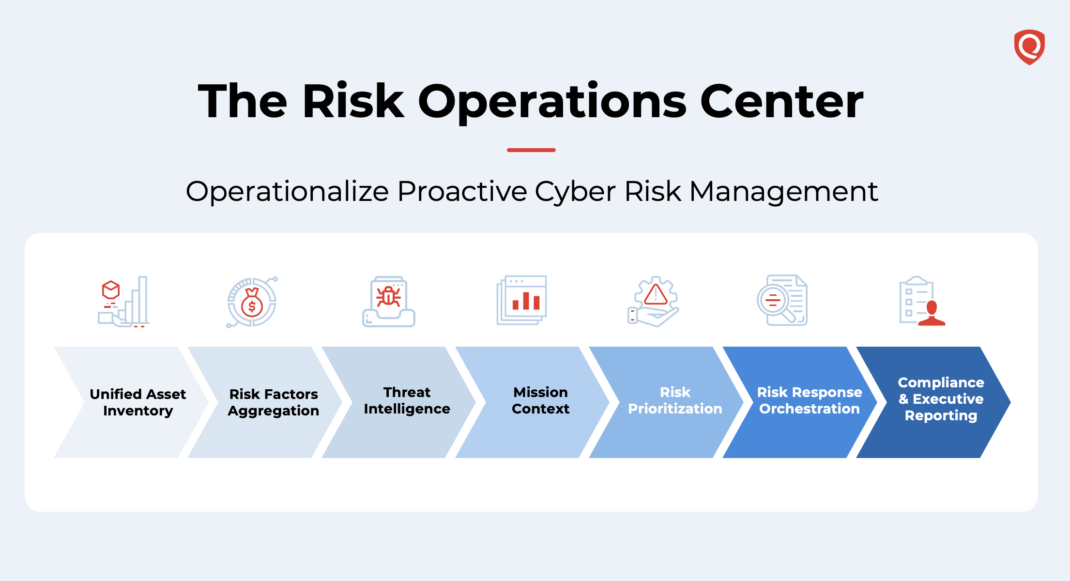
The ROC is intended to prioritize the risks that matter most with several steps, as noted above, and Qualys powers the ROC with several core capabilities:
Hyper-Prioritization with Qualys ETM
In 2025 alone, 48,172 CVEs were published, yet only 0.74% were actively weaponized. Attempting to patch everything burns finite engineering cycles, creates staff fatigue, and continues to drive a false sense of security. BOD 26-04 acknowledges this directly, designed to surface that not all patches are created equal when evaluated against context from your environment. The only scalable answer is hyper-prioritization, shrinking the problem from everything that looks scary to the specific exposures exploitable on your assets right now.
Qualys ETM operationalizes this through TruRisk and TruLens, layering threat, business, and environmental context to convert undifferentiated noise into ranked, mission-relevant queues. The final filter is exploitability validation via Agent Val and TruConfirm, which safely deploys modified payloads against live production assets to prove exploitability. In the last 12 months, this approach has achieved a 99.9% noise reduction across more than 8 million production-safe validations.

Autonomous Remediation with TruRisk Eliminate
Once vulnerabilities are validated, the challenge shifts to remediation throughput. Under BOD 26-04, agencies can no longer afford remediation as a downstream process competing for manual patch approvals. TruRisk Eliminate automates this workflow through four safeguards: AI-powered patch reliability scores, phased deployment waves, robust rollback, and patchless mitigation support. Over the last year, it has deployed 150 million patches, 40 million of them fully autonomously, with a rollback rate under 0.1%.
Post-remediation, Agent Val and TruConfirm continuously revalidate to prove attack paths are closed. This loop shrinks the Average Window of Exposure from 67 days to under 18, shifting the success metric from ticket closure to confirmed risk reduction, which is precisely the outcome BOD 26-04 is designed to drive.

AI-Speed Detection with Qualys VMDR
Prioritization and remediation are only as effective as the detection signal feeding them. Qualys VMDR delivers Six Sigma–level detection accuracy with median zero-day signature response times measured in hours, ensuring that when a vulnerability transitions to actively exploited, that state change is immediately visible across the agency’s environment.
Upcoming releases will push signature generation from hours to minutes, with AI-based noise filtering to ensure speed doesn’t sacrifice fidelity. TruConfirm coverage is also expanding to cloud, containers, identity, and misconfigurations, so that validated exploitability applies to every asset type, not just traditional endpoints.
Conclusion
BOD 26-04 formalizes what mature federal security programs have already recognized. Blanket patching cannot keep pace when frontier AI models are compressing weaponization windows to hours or less. CISA’s directive asks agencies to move to a model that is fine-grained, asset-aware, and risk-calibrated, where remediation decisions are driven by evidence rather than volume. The path to compliance runs through a closed loop where detection feeds prioritization, prioritization feeds validated exploitability, and validated exploitability feeds autonomous remediation.
That loop is what a Risk Operations Center, powered by Qualys, delivers. VMDR for AI-speed detection, TruRisk and TruLens for KEV-aligned prioritization, TruConfirm for exploit validation, and TruRisk Eliminate for autonomous remediation.