

How to Find, Mitigate, and Patch the Critical Java4Shell Flaw (CVE-2026-114938) Now

Executive Summary
Java4Shell (CVE-2026-114938) is a critical memory-corruption vulnerability in OpenJDK’s Base64 decoder. The researchers who found it rate it 9.2 under CVSS v4.0, and Oracle rates it 8.1 under CVSS v3.1. An attacker with no credentials can corrupt Java heap memory, read secrets from it, and reach remote code execution. Researchers demonstrated pre-authentication RCE on default installations of Keycloak, Jira, Confluence, Artifactory, Jenkins, and PingFederate. Unpatched OpenJDK builds from 17.0.6 onward, from any vendor, are affected when they run on x86-64 processors with AVX-512 VBMI, which includes Intel Xeon from Ice Lake through Granite Rapids and AMD EPYC from Zen 4 onward. Oracle released fixes on November 17, 2026, and a single JVM flag closes the exposure where patching has to wait. CISA has issued an alert urging organizations to patch immediately. Start with internet-facing identity, CI/CD, and collaboration systems, and assign an owner and a deadline to every system still unpatched.
What’s at Risk
A Critical Java Flaw Could Hand Attackers Your Identity and Build Servers.
Java4Shell is in the Java runtime itself, so no application or library has to be at fault for a service to be exposed. The flaw sits in handwritten assembly that speeds up Base64 decoding with AVX-512 instructions. A short malformed input makes that code write 62 bytes past the end of a buffer before Java rejects the input.
Base64 carries login headers, tokens, and file uploads, so the vulnerable code often runs before a user has authenticated. Calif, the firm that discovered the flaw, demonstrated remote code execution against the following products in their default configurations:
| Access required | Products |
| None (pre-authentication) | Keycloak, Atlassian Jira, Atlassian Confluence, JFrog Artifactory, Jenkins, PingFederate |
| Authenticated user | Apache Kafka Broker, Apache Solr, Elasticsearch, Gerrit, Netflix Spinnaker |
The researchers say these lists are not exhaustive. They also reached RCE in sample applications built on Apache Struts and Spring Boot.
The pre-authentication list is where the business risk concentrates. Identity providers issue the tokens every other system trusts, and build and artifact servers sign and ship your software. A compromise of either can expose downstream systems that trust its identities, tokens, or software artifacts.
Code execution is not the only outcome. A successful exploit chain can read Java heap memory before it runs any attacker code. That memory can hold private keys, tokens, and personal data. CISA also warns that crafted input can crash the JVM, so availability is at risk too. Java clients are exposed as well. The researchers report a client-side exploit in which a Java program is compromised simply by connecting over TLS to a malicious server.
Are You Affected?
A system is in scope only when both conditions are true. For an attack to work, attacker-controlled data must also reach the vulnerable Base64 decoding path in the application.
| Condition | Affected | Not affected |
| Java runtime | Unpatched OpenJDK-based builds from 17.0.6 onward, including 21, 25, and 27. Also Oracle Java SE 8 Enterprise Performance Pack 8u511b33-perf | Releases before 17.0.6, including standard OpenJDK 8 and 11. Also any vendor build that contains the fix |
| Processor | x86-64 with AVX-512 VBMI: Intel Xeon (Ice Lake, Sapphire Rapids, Emerald Rapids, Granite Rapids), AMD EPYC and Ryzen (Zen 4 and newer) | ARM64, and x86-64 without AVX-512 VBMI |
The runtime condition covers every OpenJDK-based distribution: Oracle Java SE, Oracle OpenJDK, Oracle GraalVM for JDK, Eclipse Temurin, Amazon Corretto, Microsoft Build of OpenJDK, Azul Zulu, BellSoft Liberica, SAP SapMachine, and Red Hat OpenJDK. There is one exception on Java 8. Oracle lists the 8u511b33-perf build of Java SE 8 as vulnerable.
On Linux, run this command to check the processor. The host meets the hardware condition only if all four flags appear.
grep -m1 ‘^flags’ /proc/cpuinfo | tr ‘ ‘ ‘\n’ | grep -E ‘^(avx512f|avx512bw|avx512vbmi|bmi2)$’
Two cautions when scoping:
- Check the runtime each application actually runs. Many products and container images bundle their own JDK, which operating system updates do not touch. CISA notes that bundled runtimes, including those in appliances, may not appear as separate entries in a software inventory.
- Use the processor condition to order the work, not to close findings. A workload on an unaffected CPU today can land on an affected one after an instance resize or a move to newer hardware.
Exploitation Status
As of November 17, 2026, we have not seen public confirmation of exploitation in the wild. Do not plan around that. The trigger is a short malformed Base64 string; the root cause and exploitation technique are public, and the researchers have said details of the bug leaked before the patch.
The researchers are holding back their product-specific exploits until organizations have had time to upgrade, and plan to publish them later. They report finding the bug with AI assistance in about an hour and having a first working exploit two hours after that, for under $200 in AI token costs. Expect others to repeat that work.
There is one limit worth knowing. No universal exploit exists: each product needs its own chain, and the technique is sensitive to network conditions. That slows mass exploitation. It does not protect a specific target such as your identity provider.
What to Do Now
Updating the Java runtime is the only complete fix. Oracle released fixed builds on November 17, 2026.
| Oracle Java SE | Fixed build |
| 8 Enterprise Performance Pack | 8u513-perf |
| 17 | 17.0.21.1 |
| 21 | 21.0.13.1 |
| 25 | 25.0.5.1 |
| 27 | 27.0.1.1 |
Other OpenJDK vendors publish on their own schedules. As of November 17, 2026, Amazon had released Corretto 17.0.21.1.2 with the fix. Use your vendor’s advisory to identify the fixed build and confirm it addresses CVE-2026-114938.
If you cannot patch today, there is a temporary workaround. It is a startup setting for Java, applied by the team that runs the application, and it takes effect after a restart. You need only one of the two options below.
- Preferred: -XX:-UseBASE64Intrinsics. This turns off the fast Base64 decoder where the bug lives. Java falls back to its standard decoder, and everything else runs as before. Applications that decode large amounts of Base64 may run slower, so test first.
- Alternative: -XX:UseAVX=2. This turns off a wider set of processor optimizations, including the vulnerable one, so the performance cost is broader. Use it only on Intel and AMD servers. Java on ARM does not accept this setting and will not start.
Neither option replaces the patch.
Either way, restart every Java process. A patch or a flag takes effect only when the JVM restarts, so verify the running process and not only the installed package. Do not rely on a reverse proxy as a control. Request buffering breaks some exploit chains but is not a general mitigation.
Reduce exposure while you wait for a patch. Take identity, build, and collaboration consoles off the open internet, or put them behind a VPN, until they are patched. CISA also suggests validating Base64 input and enforcing input-size limits at the application boundary. Size limits alone will not stop this bug, because the malformed input is very short. The JVM flag above is the more direct stopgap because it removes the vulnerable code.
Work in this order:
- Internet-facing identity providers such as Keycloak and PingFederate.
- Internet-facing Jira, Confluence, Jenkins, and Artifactory.
- Other internet-facing Java services that handle logins, tokens, or file uploads.
- Internal Java systems, starting with Kafka, Solr, Elasticsearch, Gerrit, and Spinnaker.
Assign an owner and a remediation deadline to every system that is waiting on a vendor build.
What to Watch For
CISA advises watching for unknown Java runtimes, unexpected JVM crashes, and suspicious Java processes. In practice:
- Unexpected JVM crashes or restarts on internet-facing Java services.
- Java processes that start a shell or open outbound connections they have not made before.
- Java runtimes on a host that your inventory does not account for.
How Qualys Can Help
Qualys helps you respond to Java4Shell: discover and assess exposure using Qualys CyberSecurity Asset Management (CSAM). It inventories Java installations across your assets and helps put internet-facing ones first.
software:(name:”OpenJDK” AND version>=17.0.6 AND version<18)
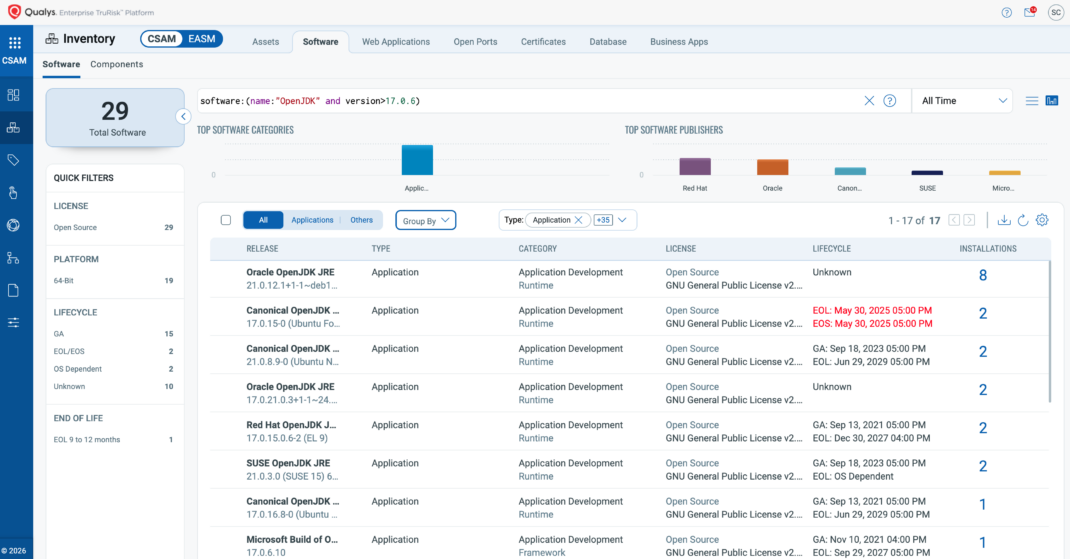
As distributions publish their own advisories, InstaScan turns them into findings without waiting for the next scheduled scan.
Detection QIDs
Qualys is releasing the following detection QIDs. We will add distribution-specific detection QIDs to this blog as they are released.
| QID | Detection Title | Release |
| 389494 | OpenJDK Remote Code Execution Vulnerability (CVE-2026-114938) (Java4Shell) | TBD, release by 3 PM PST |
| 389610 | Oracle Java Standard Edition (SE) November 2026 Critical Patch Update (CPUNOV2026) | TBD, release by 3 PM PST |
| 389608 | Amazon Corretto 17, 21, 25 and 27 Security Update (NOV26) | TBD, release by 3 PM PST |
References
- Calif: Java4Shell: Write once, RCE everywhere
- Oracle: Critical Security Patch Update, November 2026
- CISA: Critical Java Vulnerability Requires Immediate Patching: https://www.cisa.gov/news-events/alerts/2026/11/17/critical-java-vulnerability-requires-immediate-patching