

What Is ISPM? How It Differs from IAM, PAM, IGA, and IDaaS

Table of Contents
- What Is Identity Security Posture Management (ISPM)?
- Where ISPM Fits in the Identity Security Stack
- When Does an Organization Need ISPM
- ISPM vs.IAM, PAM, IGA, andIDaaS
- Where ISPM Fills the Gap
- How ISPM Fits into the Identity Security Architecture
- How ISPM Enables Continuous Monitoring and Posture Change Detection
- ISPM Platform Evaluation Checklist
- How Qualys ETM Identity Complements IAM, PAM, IGA, and IDaaS
- Conclusion: ISPM Is the Continuous Risk Layer of the Identity Stack
- Frequently Asked Questions (FAQs)
Key Takeaways
- Identity Security Posture Management (ISPM) is the continuous risk and posture layer of the identity stack not a replacement for Identity and Access Management (IAM), Privileged Access Management (PAM), Identity Governance and Administration (IGA), or Identity-as-a-Service (IDaaS), but the layer that continuously assesses the exposure those systems create.
- IAM authenticates and authorizes, PAM secures privileged access, IGA governs the identity lifecycle, and IDaaS delivers identity services in the cloud — each does its job well, but none continuously measures whether the resulting access is actually safe.
- Gaps show up because identity data is fragmented, granted access isn’t the same as effective risk, posture changes daily, and human and non-human identities need a unified view.
- ISPM operates as a loop — discover, assess, correlate, prioritize, remediate, verify — closing the gap between quarterly certifications and real-time exposure.
- Qualys ETM Identity operationalizes this: unified discovery, Identity TruRisk™ scoring, Active Directory (AD)-native attack-path and domain-trust analysis, and closed-loop remediation through the identity tools you already run.
What Is Identity Security Posture Management (ISPM)?
ISPM is the continuous process of discovering identities and access relationships, assessing configurations, measuring exposure, and guiding remediation across on-premises, Software as a Service (SaaS), cloud, and hybrid environments — for human and non-human identities alike. Where identity infrastructure decides whether an identity can get in, ISPM assesses whether it’s safe once it’s there.
Where ISPM Fits in the Identity Security Stack
ISPM works across the identity security stack without replacing the tools already in place. Unlike IAM, PAM, IGA, or IDaaS, it does not authenticate users, grant access, or store credentials. Instead, it provides visibility into identity-related risk and helps organizations identify where action is needed.
ISPM also goes beyond aggregating alerts or providing point-in-time assessments. By continuously evaluating identity posture, correlating risk, and prioritizing remediation, organizations can identify changes and exposures that periodic audits may miss.
The goal of ISPM is not to consolidate or replace existing identity security tools, but to make them more effective by providing the context needed to prioritize and address identity risk.
When Does an Organization Need ISPM
Picture a CISO at an enterprise with more than 10,000 employees, running IAM, PAM, IGA, IDaaS, AD, and Entra ID, each tool doing its job, each producing its own alerts.
The problem isn’t a lack of data. It’s too much of it. Four tools can easily mean thousands of open findings with no single view of which ones matter. Somewhere in that pile could be the 10 identities that, if compromised today, would cause serious damage, but nothing tells the CISO which 10.
The security team spends more time filtering out noise than closing the attack paths that matter, so high-risk exposures remain unresolved, buried under everything else. This is the gap ISPM closes: not another alert stream, but a way to surface the small number of identities that represent real business risk.
A few recurring conditions can signal that an identity stack has reached this point:
- Identity Data Is Fragmented Across Multiple Systems
AD and Entra ID coexistence, multiple IDaaS or Identity Providers (IdPs), separate PAM and IGA platforms, and SaaS access that no single console can represent. No system shows the complete effective-access picture. - Granted Access and Effective Risk Are Not the Same
Recurring access-review findings, unowned service accounts, dormant users, shadow identities, and missing MFA often look fine individually but turn risky when combined with nested groups, stale credentials, local privilege, or an attack path to a critical resource. - Posture Changes Faster Than Reviews Can Track It
Joiner-mover-leaver events, new service accounts, group changes, and trust changes happen daily. Quarterly certifications and point-in-time reports can’t keep pace, so findings pile up faster than teams can manually translate them into IAM, PAM, IGA, or ITSM actions, with no reliable way to confirm exposure was actually removed. - Identity Risk Cannot Be Prioritized Across Human and Non-Human Identities
Every tool reports findings, but none tell the CISO which identities or attack paths, across employees, service accounts, bots, API keys, or AI agents, create the greatest business risk. A real threat and a low-priority misconfiguration end up looking equally urgent in the queue.

See How Zero Trust Extends Beyond IAM
Understand how identity, vulnerability management, and policy compliance fit into the CISA, DoD, and NIST Zero Trust models and what it takes to implement one, especially for federal and regulated environments.
ISPM vs. IAM, PAM, IGA, and IDaaS
Identity security tools solve different parts of the access problem, but their boundaries can blur in practice. IAM controls authentication and access, PAM protects privileged accounts, IGA governs identity lifecycles, and IDaaS delivers identity services through the cloud. ISPM takes a different approach: it continuously scans these systems to assess the security of the access they create.
At a Glance
| Category | Purpose | System Role | Output |
| IAM | Authenticate & authorize | Enforcement | Access decisions |
| PAM | Secure privileged access | Enforcement | Controlled sessions |
| IGA | Govern identity lifecycle | Governance | Approved access |
| IDaaS | Deliver IAM as a service | Enforcement | Cloud authentication |
| ISPM | Continuously assess exposure | Risk assessment | Prioritized, verified risk |

Where ISPM Fills the Gap
| Category | What IAM Does Best | Where ISPM Adds |
| IAM | Directories, authentication, SSO, MFA, federation, and authorization — delivered on-premises, via cloud services, or through an IDaaS provider. | Validates how IAM policies operate across systems, finds identities outside the IAM system, correlates access with asset risk, and feeds findings back into IAM rather than replacing it. |
| PAM | Privileged credential vaulting and rotation, session brokering and recording, just-in-time access, and accountability for administrative activity. | Surfaces privileged identities PAM hasn’t onboarded, flags conflicting privilege grants, and prioritizes which identities should be brought under PAM control or rightsized first. |
| IGA | Joiner-mover-leaver workflows, provisioning, deprovisioning, role management, access reviews, certifications, and governance reporting. | Supplies current identity risk, usage, attack-path, and asset context that improves certification decisions, and reveals entitlements the IGA catalog doesn’t fully represent. |
| IDaaS | Cloud-hosted authentication, SSO, MFA, federation, directories, and centralized identity services without operating the underlying infrastructure. | Monitors how IDaaS identities and policies contribute to enterprise risk, correlating findings with AD, PAM, IGA, and assets outside the provider’s view. |
How ISPM Fits into the Identity Security Architecture
A layered model clarifies where each piece fits: identity sources and IDaaS authenticate identities; IAM and PAM enforce access controls; IGA governs the lifecycle decisions that underlie it; and ISPM provides continuous visibility, prioritization, and remediation orchestration across the stack.
Identity architecture splits into three layers: HR systems, directories, and IGA act as systems of record; IAM, IDaaS, PAM, and applications enforce access decisions; ISPM sits above both, continuously assessing posture and orchestrating remediation across the stack.
The Closed-Loop Identity Risk Workflow
What makes ISPM a posture and risk layer, not another provisioning or authentication product, is a continuous loop: Discover, Assess, Correlate, Prioritize, Remediate, Verify.

1. Discover: Comprehensive Identity and Access Discovery
Discovery covers users, groups, privileged and service accounts, machine and shadow identities, applications, and entitlements across identity stores, including data already sitting in IAM, PAM, IGA, and IDaaS tools.
Qualys ETM Identity surfaces shadow admins, ownerless service accounts, and stale credentials by tracking lifecycle state, last logon, password age, and account activation, not just who exists, but who’s been forgotten.

2. Assess: Misconfiguration, Exposure & Threat Alignment
ISPM should identify misconfigurations, control gaps, excessive privilege, and insecure configurations, and evaluate exposure against security best practices and threat frameworks.
Qualys ETM Identity identifies weaknesses such as legacy authentication protocols, unrestricted delegation rights, weak password policies, and other AD misconfigurations, then maps them to MITRE ATT&CK techniques so teams understand how an attacker could exploit the weakness, not just that a control is failing.

3. Correlate: Identity and Asset Risk
ISPM should connect identity findings to asset, vulnerability, and business context, since a finding in isolation rarely reflects the real risk posed by a combination of factors.
Qualys ETM Identity correlates identity posture with asset exposure to surface toxic combinations and actionable relationships, for example, identifying privileged users without MFA who have access to hosts affected by ransomware vulnerabilities.

4. Prioritize: Attack-Path Analysis, Domain Trust Map, and Identity TruRisk™
ISPM should trace indirect privilege through nested groups, chained permissions, trusts, sessions, and local administrator rights, and score risk using identity type, privilege level, authentication posture, misconfigurations, attack-path reachability, asset criticality, and business impact, expressed in dollar terms, so risk isn’t just measured, it’s priced.
Qualys ETM Identity generates an AI summary explaining each attack chain and its impact. It detects Foreign Security Principals (FSPs) to catch privileges that cross forest boundaries and that most tools miss entirely.

Its Domain Trust Map visualizes parent-child, forest, and external trust relationships, flagging issues like a missing quarantine flag or a weak password policy inherited across a trust boundary, the kind of misconfiguration that turns one compromised domain into many.

Identity TruRisk™ combines a 1-5 asset criticality score with vulnerability severity and misconfigurations, then breaks down the risk factors driving the score so teams see what’s pushing risk up and can prioritize fixes based on what a compromise would actually cost.


5. Remediate: Guided Recommendations & Response Orchestration
ISPM should recommend corrective action, route work to the right owner, integrate with ITSM, and support approved automation.
Qualys ETM Identity pairs every finding with detection rationale and step-by-step guidance, then enables remediation through 200+ AD policy controls and scripts, one-click identity actions, isolation, custom playbooks, and ITSM workflows.

6. Verify: Risk Reduction & Evidence
Remediation without verification is a status update. ISPM should retest the fix, confirm the exposure is closed, and preserve timestamped evidence that the risk was actually reduced.
Qualys ETM Identity retests automatically and keeps a timestamped record, turning “we fixed it” into something you can actually prove. Each confirmed fix also updates the identity’s Identity TruRisk™ score, which rolls up into the organization’s overall TruRisk™ score, so verified remediation shows up not just as a closed finding, but as a measurable drop in enterprise risk.
How ISPM Enables Continuous Monitoring and Posture Change Detection
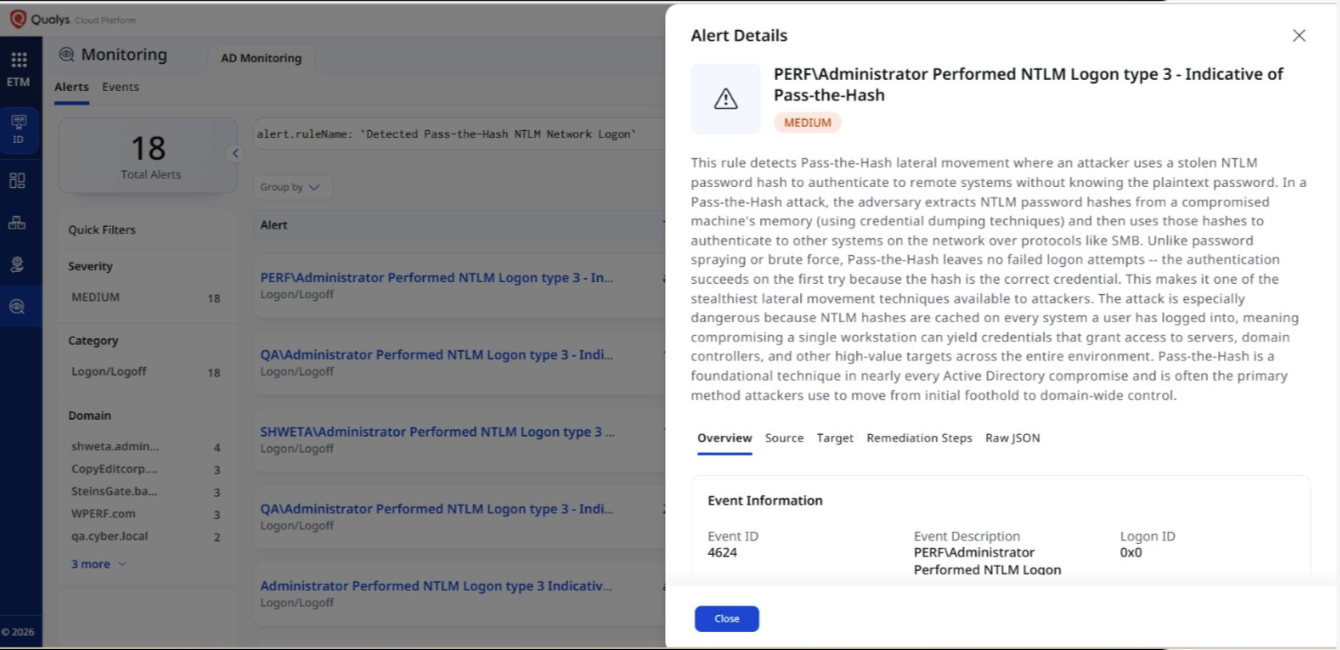
New privileged access, MFA disablement, group changes, policy tampering, and posture drift are detected in real time rather than at the next certification cycle.
Qualys ETM Identity’s real-time AD monitoring converts directory events into severity-rated alerts for attack techniques like Pass-the-Hash and Kerberos abuse, each with source and target accounts and a four-step containment path: isolate, harden configuration, restrict network access, and begin forensic collection.
ISPM Platform Evaluation Checklist
- Complete human and non-human identity discovery
- Broad integration across AD, Entra ID, IDaaS, IGA, PAM, SaaS, and cloud
- Effective-access analysis, not just granted permissions
- Attack-path and trust-relationship analysis
- Explainable, transparent risk scoring
- Real-time monitoring and remediation guidance
- Automated post-fix verification and audit evidence
- Role-based access, open APIs, and enterprise-scale performance
- Measurable risk reduction over time
How Qualys ETM Identity Complements IAM, PAM, IGA, and IDaaS
Qualys ETM Identity discovers every identity across AD, Entra ID, and Okta, and third-party connectors to surface misconfigurations, stale privileges, and authentication gaps. Everything correlates into Identity TruRisk™, surfacing toxic combinations, attack paths, and domain trusts to prioritize by blast radius rather than static severity; teams can also query identity data directly with Identity Qualys Query Language (QQL). Remediation spans 200+ AD controls, Identity Actions, and Jira/ServiceNow workflows, with automatic re-scoring to confirm that exposure was actually closed. Qualys provides the risk and remediation layer, while IAM, PAM, IGA, and IDaaS continue to do what they already do well.
Add Continuous Identity Risk Management to Your Existing Stack
Unify identity exposures, prioritize exploitable paths with Identity TruRisk™, and route remediation through the systems your teams already use.
Conclusion: ISPM Is the Continuous Risk Layer of the Identity Stack
IAM, PAM, IGA, and IDaaS remain essential: they authenticate, enforce, govern, and deliver identity services. ISPM adds the continuous visibility and risk context to confirm that those controls and the resulting access stay secure across the enterprise.
Add Continuous Identity Risk Management to Your Existing Stack
Unify identity exposures, prioritize exploitable paths with Identity TruRisk™, and route remediation through the systems your teams already use.
Frequently Asked Questions (FAQs)
What is ISPM?
Identity Security Posture Management is the continuous process of discovering identities, assessing configurations, measuring exposure, and guiding remediation across human and non-human identities.
Does ISPM Replace IAM, PAM, IGA, or IDaaS?
No. IAM, PAM, IGA, and IDaaS each enforce or govern access: authenticating users, securing privileged credentials, managing identity lifecycles, or delivering identity services in the cloud. ISPM continuously assesses whether the access those systems grant is actually secure and routes what it finds back through the tools you’re already running.
Can ISPM Help with Non-Human Identities?
Yes. ISPM extends identity security beyond employees and privileged users to service accounts, machine identities, application identities, bots, API keys, and other non-human identities that can introduce risk.
How is Granted Access Different from Effective Risk?
Granted access means a system has approved the request. Effective risk depends on everything that access touches, including group nesting, credential age, authentication strength, and whether it opens a path to something critical. Two identities with the same “approved” status can carry very different levels of real-world exposure.