

Node.js Patches Brotli Remote Code Execution Flaw: Find Vulnerable Runtimes Before Attackers Do

Last updated on: November 11, 2026
Table of Contents
- Why This Release Needs Attention Now
- Why Updating Application Dependencies Is Not Enough
- What the Vulnerabilities Affect
- Node.js by the Numbers: Nine in 10 Installations Are Unpatched or Unsupported
- Fixed Versions and Upgrade Guidance
- What Qualys Customers Can Do
- How Qualys Finds and Closes Node.js Exposure
- Connect Your AI Assistant to Qualys in Three Steps
- What This Means for Security Teams
Executive Summary
On October 21, 2026, Node.js released fixes for 10 vulnerabilities across its three supported release lines: 22.x, 24.x, and 26.x. Four are rated High. The most severe, CVE-2026-111497, is an out-of-bounds write in the bundled Brotli decoder that Node.js says permits remote code execution. These flaws live in the Node.js runtime itself, not in application packages, so application dependency checks will not surface them. Qualys Threat Research Unit data shows that nine in 10 Node.js installations are either unpatched or on lines that will never receive these fixes. Qualys customers can detect exposure with InstaScan as soon as the advisory is published and find affected runtimes across hosts, containers, and cloud workloads, including copies outside standard install paths. They can then prioritize those exposed to the internet, patch with TruRisk Eliminate, and confirm each fix.
Why This Release Needs Attention Now
The four high-severity vulnerabilities affect two areas almost every Node.js service relies on: compressed data and outbound connections.
- Brotli decompression (CVE-2026-111497): This flaw is in the code that decompresses Brotli data. Any service that unpacks Brotli content it didn’t create is exposed, and Node.js says the flaw can permit remote code execution.
- Hostname and certificate checks (CVE-2026-105482, CVE-2026-105483, CVE-2026-106069): These flaws weaken Node.js’s ability to verify hostnames and certificates. Services that connect to hosts on behalf of users are most at risk.
Where things stand now:
- Scores confirm the urgency: CVE-2026-111497 now has a CVSS 4.0 score of 9.2 (Critical). Its QVSS score, which adds Qualys threat intelligence, is higher. See the latest score and threat indicators in ETM below.
- Patches are available: Node.js fixed these flaws in 22.23.4, 24.22.1, and 26.12.1. Qualys patches are available in TruRisk Eliminate for 22.x, 24.x, and 26.x. Check each patch’s reliability score before deploying.
- No official workarounds: Node.js has not published workarounds. Upgrading the runtime is the only complete fix. The Qualys TRU mitigations later in this post reduce exposure while teams patch.
- Unsupported lines stay vulnerable: Only 22.x, 24.x, and 26.x received fixes. All other lines, including 25.x, 20.x, and earlier, remain vulnerable and must be upgraded to a supported release.
Why Updating Application Dependencies Is Not Enough
Updating application dependencies alone will not resolve these issues. The vulnerable code is included in the Node.js runtime, which encompasses runtimes embedded in container images and single-executable applications (SEAs).
Node.js also often runs from nonstandard locations:
- Version managers such as nvm
- Application folders
- Bundled runtimes
- SEAs
- Container images, running containers, and serverless functions such as AWS Lambda Node.js runtimes
What the Vulnerabilities Affect
The vulnerabilities span zlib, DNS, TLS, HTTP, crypto, and the Permission Model. Three of the four high-severity issues weaken hostname or certificate validation, which matters for any service that makes outbound TLS or DNS calls on behalf of users.
| CVE | Severity | Module | Description | Affected lines |
| CVE-2026-111497 | High | zlib (Brotli) | Brotli decoder out-of-bounds write; potential remote code execution | 22.x, 24.x, 26.x |
| CVE-2026-105482 | High | DNS | DNS resolution truncation involving embedded NUL characters | 22.x, 24.x, 26.x |
| CVE-2026-105483 | High | TLS | TLS hostname validation bypass using fullwidth IP digits | 24.x, 26.x |
| CVE-2026-106069 | High | TLS | TLS hostname validation bypass with noncanonical IP addresses | 22.x, 24.x, 26.x |
| CVE-2026-105481 | Medium | HTTP | HTTP keep-alive response handling issue | 22.x, 24.x, 26.x |
| CVE-2026-106072 | Medium | TLS | Improper certificate validation for unusual IPv4 representations | 22.x, 24.x, 26.x |
| CVE-2026-106074 | Medium | crypto | Repeated random values across startup snapshots | 22.x, 24.x, 26.x |
| CVE-2026-106070 | Low | zlib (ZipFile) | ZIP validation exposes attacker-controlled bytes | 26.x |
| CVE-2026-106071 | Low | Permission Model | Permission Model filesystem over-grant | 26.x |
| CVE-2026-106073 | Low | fs / Permission Model | Permission Model bypass using fs.realpathSync | 22.x, 24.x, 26.x |
High-Severity Vulnerabilities
CVE-2026-111497 (Brotli). A crafted Brotli stream can cause the decoder to write outside its allocated memory bounds. Node.js classifies this outcome as a remote code execution vulnerability. Services that decompress Brotli data from untrusted sources, such as HTTP clients and proxies that accept the Content-Encoding: br, or services that handle uploaded compressed files, are particularly at risk.
CVE-2026-105482 (DNS). The functions dns.resolve*, dns.reverse, and the Resolver class send names to c-ares as C strings. Therefore, if an embedded NUL character is present, it will truncate the name. An application has the ability to validate one hostname against an allowlist while querying a different name. The dns.lookup function remains unaffected by this issue.
CVE-2026-106069 (TLS). The `tls.checkServerIdentity` function can verify a non-canonical IP address, such as one in octal or shortened form, against a certificate for one address while the connection is directed to a different one. This vulnerability allows an attacker to present a certificate that is valid for an endpoint that does not actually belong to them.
CVE-2026-105483 (TLS). Hostnames using Unicode fullwidth digits normalize to an IP address and can match a certificate issued for that IP. This issue only affects the 24.x and 26.x lines.
Medium- and Low-Severity Vulnerabilities
- CVE-2026-105481 (Medium, HTTP): With
http.Agentkeep-alive, a server can send a response through an idle reused socket before the next request, which Node.js will interpret as the response to that request. - CVE-2026-106072 (Medium, TLS): Certificates with DNS names were accepted for non-canonical IPv4 endpoints. This issue has been resolved in the same commit as CVE-2026-106069.
- CVE-2026-106074 (Medium, crypto): Cached values for
crypto.randomUUIDandcrypto.randomIntwere stored in startup snapshots, causing processes that initiated from the same snapshot to produce identical initial values. Only SEAs usinguseSnapshotor user-land snapshots are affected. - CVE-2026-106070 (Low, zlib): In the experimental
zlib.ZipFileAPI (added in 26.8.0), a read after a failed header check could return bytes from the wrong file position. - CVE-2026-106071 (Low, Permission Model): Using Wildcard paths in the
--allow-fs-reador--allow-fs-writeoptions may provide access to more files paths than originally intended. - CVE-2026-106073 (Low, fs):
fs.realpathSyncbypassed the Permission Model check that its sibling functions perform, allowing calls on ungranted paths.
Node.js by the Numbers: Nine in 10 Installations Are Unpatched or Unsupported
The Qualys Threat Research Unit analyzed anonymized data to measure exposure to the October 2026 Node.js vulnerabilities.
We found 3.3 million Node.js package installations, and 15% of them are on internet-facing assets, within reach of remote attackers.
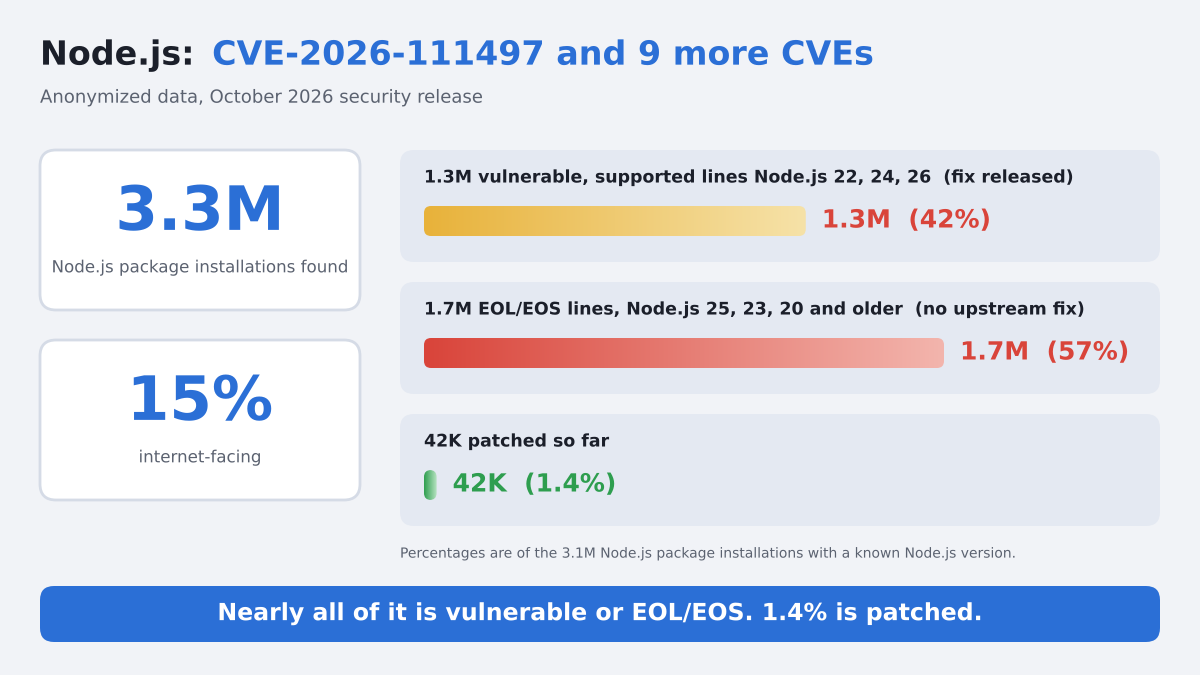
Across those installations:
- 1.3 million run supported lines, Node.js 22, 24, and 26. A fixed release is available for these versions, but it has not been applied yet.
- 1.7 million run end-of-life or end-of-support lines, Node.js 25, 23, 20, and older. These lines get no upstream fix, so moving to a supported line is the only remedy.
- Only 42,000 have been patched so far.
The takeaway: More than half of Node.js installations run versions that will never receive these fixes, and nearly all of the rest have not been patched yet.
Fixed Versions and Upgrade Guidance
Each supported line has a fixed release, and any subsequent release in the same line also includes the fixes.
Node.js version 26 will become LTS on October 28, 2026. Teams using version 26.x should upgrade to version 26.12.1 before this transition.
| Node.js branch | Security Update | Priority |
| 22.x LTS | 22.23.4 | High |
| 24.x LTS | 24.22.1 | High |
| 26.x | 26.12.1 | High |
| 25.x, 23.x, 21.x | No Fix | Upgrade to a supported branch |
| 20.x and older | End of Life | Upgrade to a supported branch |
Simply updating application dependencies does not resolve these issues. The vulnerable code is included with the Node.js runtime, which encompasses runtimes found in container-based images and single-executable applications (SEAs).
What Qualys Customers Can Do
Qualys customers can identify every vulnerable Node.js runtime across hosts, containers, and cloud workloads, and track remediation in a single view. Detections for the October 2026 release are detailed below.
| QID | CVE(s) | Fix (22.x / 24.x / 26.x) | Title | Platform |
| 389117 | CVE-2026-105481, 105482, 106069, 106072, 106073, 106074, 111497 | 22.23.4 / 24.22.1 / 26.12.1 | Node.js Multiple Security Vulnerabilities | Windows, Windows DeepScan, Apple MacOS |
| 389119 | CVE-2026-105483 | Not affected / 24.22.1 / 26.12.1 | Node.js TLS Certificate Hostname Bypass Vulnerability | Windows, Windows DeepScan, Apple MacOS |
| 389122 | CVE-2026-106070, 106071 | Not affected / Not affected / 26.12.1 | Node.js Multiple Security Vulnerabilities | Windows, Windows DeepScan, Apple MacOS |
| 106287 | EOL | No patch. Migrate to a supported line | EOL/Obsolete Software: Node.js 18.x Detected | Windows, Unix |
| 106242 | EOL | No patch. Migrate to a supported line | EOL/Obsolete Software: Node.js 16.x Detected | Windows, Unix |
| 106401 | GENERIC-MAP-NOMATCH | 20.x | Node.js 20.x Detected | Microsoft Windows, Unix, Apple MacOS |
Extend Node.js Remediation Verification to Web Applications and APIs with TotalAppSec
Patching vulnerable Node.js runtimes is the crucial first step in addressing the Brotli vulnerability (CVE-2026-111497). Qualys TotalAppSec extends remediation verification to the web applications and APIs running on these runtimes.
After applying the necessary security patch updates, rescan your web applications and APIs with TotalAppSec using QID 533085 to validate that the Node.js Brotli vulnerability has been resolved.
Important: Use caution when employing QID 533085. This intrusive check may cause applications or APIs running on vulnerable Node.js versions to crash, potentially disrupting service availability. Therefore, run this check only in QA/test environments or against systems confirmed to have patched Node.js runtimes. Do not enable QID 533085 on unpatched or unverified production applications or APIs.
For comprehensive remediation verification, use Qualys VMDR or TotalCloud to check the installed Node.js runtime versions and patch status in conjunction with TotalAppSec’s application-level assessment.
How Qualys Finds and Closes Node.js Exposure
The Qualys Enterprise TruRisk Platform takes teams from advisory to verified fix in six stages, using the inventory and telemetry they already have.
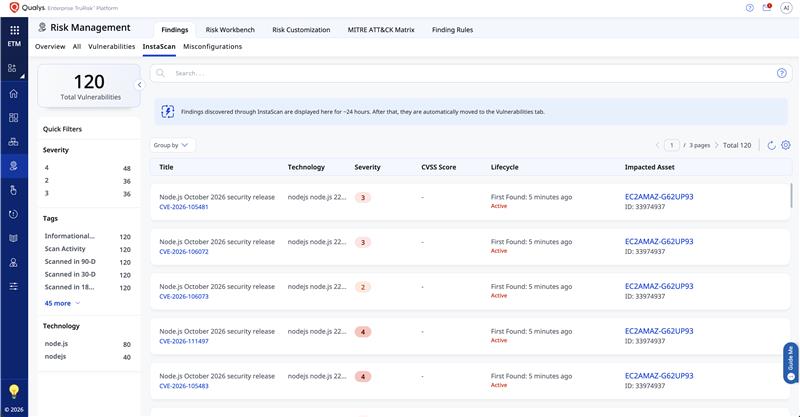
- Detect at disclosure with InstaScan. InstaScan, powered by Agent Insta, matches new advisories against your existing software inventory, so Node.js findings surface without a new scan job. See how InstaScan surfaced Node.js exposure.
- Find every runtime with CSAM and Qualys Deep Scan. List assets running on affected Node.js, including copies outside standard install paths and in cloud and container workloads. See how to find every affected Node.js runtime See how to find every affected Node.js runtime.
- Cover cloud, containers, and serverless with TotalCloud and Container Security. Find affected Node.js across cloud workloads, images, and serverless functions, and see which copies are actually in use See the full cloud and container details.
- Prioritize with Enterprise TruRisk Management (ETM). TruRisk scoring adds asset and exposure context, so teams can fix the most exposed runtimes first. See how to prioritize Node.js remediation.
- Patch with TruRisk Eliminate. Qualys-published patches are available for the 24.x and 26.x lines; teams on 22.x should upgrade the runtime manually until a patch is available. See patch reliability and deployment guidance.
- Confirm the fix. After upgrading, rescan with Cloud Agent, TotalAppSec, or Container Security and confirm the detection QIDs are closed. See the full remediation checklist.
Detect Node.js Exposure at Disclosure with InstaScan
On most platforms, a security release kicks off a waiting game. Wait for the vendor to write a signature. Wait for the next scan window. Wait for the results to process. Only then does a team learn where it’s exposed, often days after the advisory went live. InstaScan ends that cycle.
InstaScan ends that cycle. Within minutes of the October 2026 Node.js security release going public, InstaScan, powered by Agent Insta, correlated the new CVEs against the asset and software telemetry Qualys customers already collect and surfaced exposed Node.js runtimes as live findings: tagged by CVE, including the Brotli remote code execution flaw (CVE-2026-111497), rated by severity, and tied to the impacted asset. No scan to schedule. No waiting for the next scan window. No processing lag.
That matters for a release like this one. The vulnerable code lives in the runtime itself, not in a package manifest, and it hides in version managers, container images, single-executable apps, and serverless functions that dependency checks never touch. InstaScan doesn’t care where the runtime is installed; it reasons from what’s actually on the asset and flags exposure the moment a new advisory lands. The result is a view of Node.js risk that is already prioritized and already tied to the assets that matter, long before a traditional detection pipeline would have surfaced the first finding.
That’s scanless scanning in action, and it’s why Qualys customers knew exactly where they stood on Node.js while everyone else was still waiting on their scanner.
Find Every Node.js Runtime with CSAM and Qualys Deep Scan
Deep Scan identifies vulnerable Node.js runtimes in custom application folders, secondary drives, and other configured directories. Findings appear in VMDR with the full binary path, installed version, and recommended fixed version. This information gives security and IT teams the details they need to locate and address overlooked installations.
Run the following queries in CSAM > Inventory > Assets.
| Step | Action |
| All assets with Node.js installed | (software: ((name: “Node.js”))) |
| Assets running end-of-life Node.js (21.x and earlier, 23.x, 25.x) | ((software: (((name: “Node.js”) AND (version: (*..22.0.0)))))) |
| Node.js on your most critical assets | ((asset.criticalityScore: [4..*)) AND (software: ((name: “Node.js”)))) |
Identify Vulnerable Node.js Across Cloud Workloads, Containers, and Serverless Functions
With Qualys TotalCloud and Container Security, customers can use Qualys Query Language (QQL) to quickly identify cloud workloads, containers, images, serverless functions, VM images (AMIs), and code built on affected Node.js versions, including older releases that have reached end-of-life or end-of-support.
Customers can use the following QQL query to find images and containers running affected Node.js versions:
software: (name: "nodejs" and version: [0 ... 22.23.3])
or software: (name: "nodejs" and version: [23.0.0 ... 23.11.1])
or software: (name: "nodejs" and version: [24.0.0 ... 24.22.0])
or software: (name: "nodejs" and version: [25.0.0 ... 25.9.0])
or software: (name: "nodejs" and version: [26.0.0 ... 26.12.0])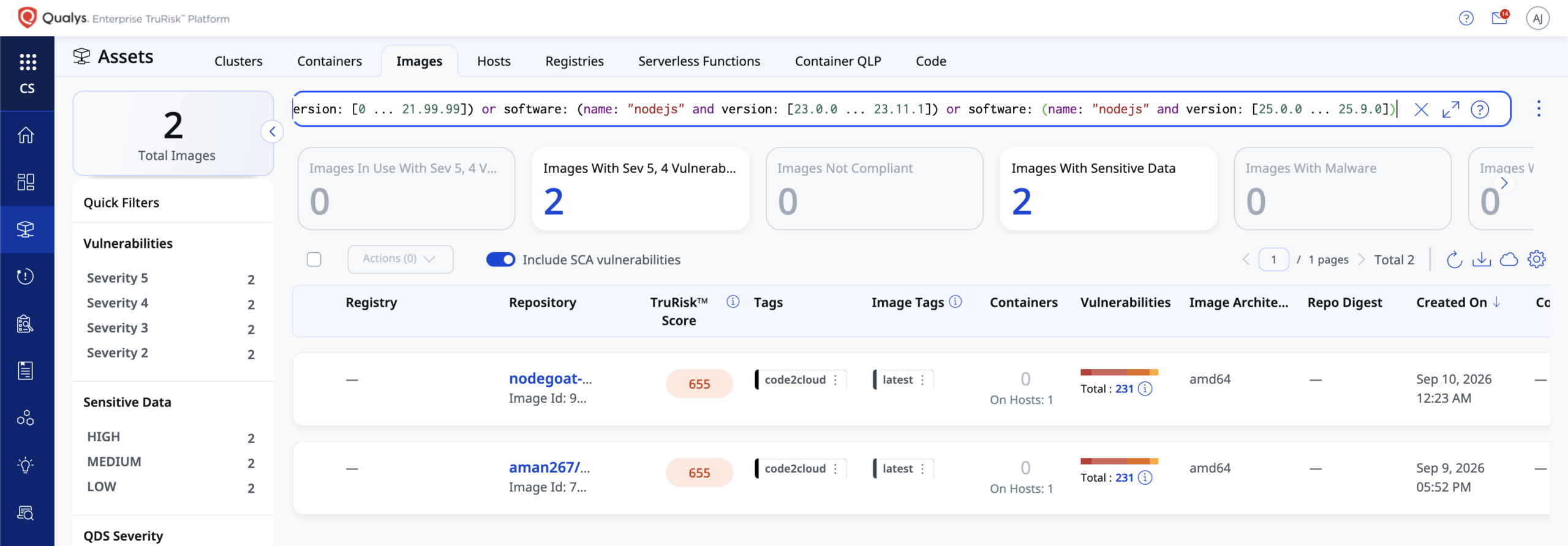
Beyond identifying vulnerable images, Qualys provides visibility into the deployed containers associated with those images, helping teams understand where affected Node.js packages are running. With the Qualys Runtime Sensor, customers can further distinguish packages that are simply present in an image from those actively in use or runtime reachable, enabling more precise risk prioritization.
Security teams can then focus remediation on the most critical workloads, update affected Node.js packages, rebuild and redeploy container images, and verify that exposures have been eliminated.
The outcome is a unified view of impacted Node.js runtimes across hosts, containers, and serverless workloads, ranked by real exposure and tracked through to a confirmed fix.
Prioritize with Enterprise TruRisk Management (ETM)
Not every Node.js runtime carries the same risk, so not every affected asset needs to be patched first. ETM combines Node.js findings from Qualys and third-party sources, removes duplicates, and gives each one a TruRisk score. That score weighs Qualys threat intelligence against each asset’s business criticality and exposure.
From CVSS to QVSS
CVSS rates how severe a flaw could be. QVSS adds live Qualys threat intelligence and the customer’s own asset impact to show which flaws attackers are exploiting now and need fixing first.
With that context, the order of remediation becomes clear:
- Fix first: Internet-facing services that decompress untrusted Brotli data (CVE-2026-111497). They are the most direct path to remote code execution.
- Fix next: Services that open TLS connections to user-supplied hosts (CVE-2026-106069, CVE-2026-105483). Here, a hostname validation bypass can expose traffic to interception.
- Plan upgrades: Runtimes on end-of-life lines. They will never receive a fix, so they need an upgrade plan rather than a patch.
With this approach, teams focus their efforts on the assets an attacker can actually reach, not on every Node.js installation in the environment.
Track Exposure with the Node.js Dashboard
Once priorities are set, the dashboard turns them into a view that teams can act on. It shows Node.js runtimes across the customer’s environment, which ones are at risk, and what to fix first:
- Know the full Node.js footprint. Assets running Node.js and how each one was discovered. This includes runtimes in container images, serverless functions, and bundled or nonstandard install paths.
- See where the real risk is. Internet-facing runtimes, instances grouped by affected release line (22.x, 24.x, 26.x), and end-of-life or unsupported versions in their own group.
- Prioritize and act fast. High-TruRisk assets grouped by operating system, with each detection’s age and status (active, fixed, or reopened).
As patches roll out, the dashboard tracks progress and confirms that QIDs 389117, 389119, and 389122 close after the rescan, so teams can see that the risk is gone and not just assume the patch worked.
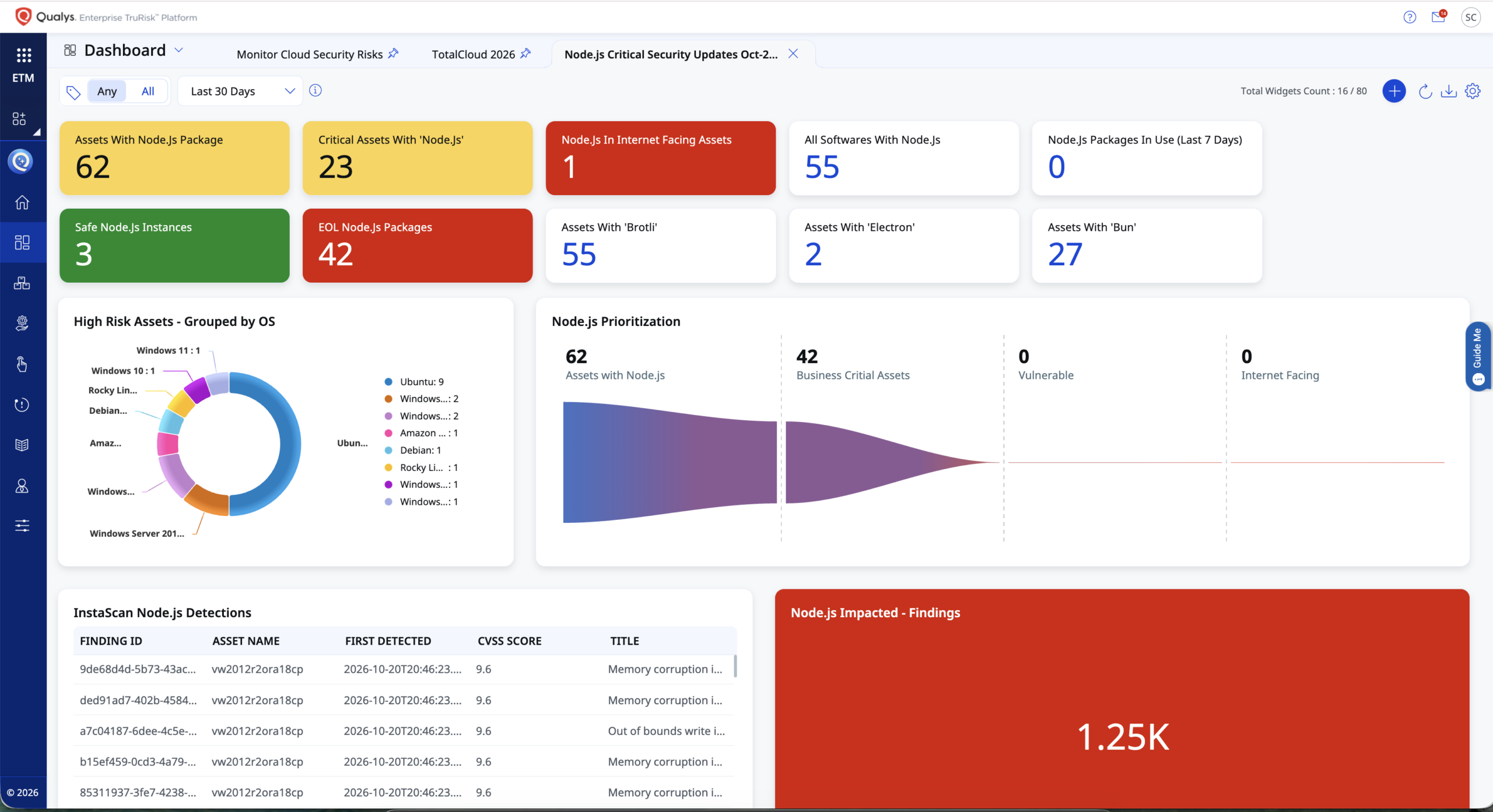
Download the Node.js exposure dashboard today.
Reduce Exposure and Patch
Upgrading the runtime is the only complete fix. Use the interim steps below to narrow exposure while you plan the upgrade, then deploy the fixed releases.
Reduce Exposure Before You Patch
Node.js has not published workarounds, so the interim steps below come from the Qualys Threat Research Unit (TRU). They narrow specific attack paths; they do not make an unpatched runtime safe.
- Avoid Brotli decompression of untrusted input where possible. Limit compressed payload size and decompression ratio at the reverse proxy or WAF.
- Resolve user-supplied names with
dns.lookupinstead ofdns.resolve*, and reject hostnames containing NUL characters. - Convert IP addresses to canonical form before they reach a TLS connection. Reject fullwidth and other non-canonical forms.
- Disable
keepAliveonhttp.Agentfor connections to untrusted servers. - Do not rely on the Permission Model as a security boundary on affected versions.
Patch with Confidence
Node.js has released fixes, and Qualys-published patches are already available in TruRisk Eliminate for the 22.x, 24.x, and 26 lines.
Customers can use the following QQL query in the patch catalog to find the patches associated with these vulnerabilities. Any of these patches that are missing from a customer’s environment appear in the results.
patch.cveId:[CVE-2026-111497, CVE-2026-105482,CVE-2026-105483,
CVE-2026-106069,CVE-2026-105481,CVE-2026-106072,CVE-2026-106074,
CVE-2026-106070,CVE-2026-106071,CVE-2026-106073]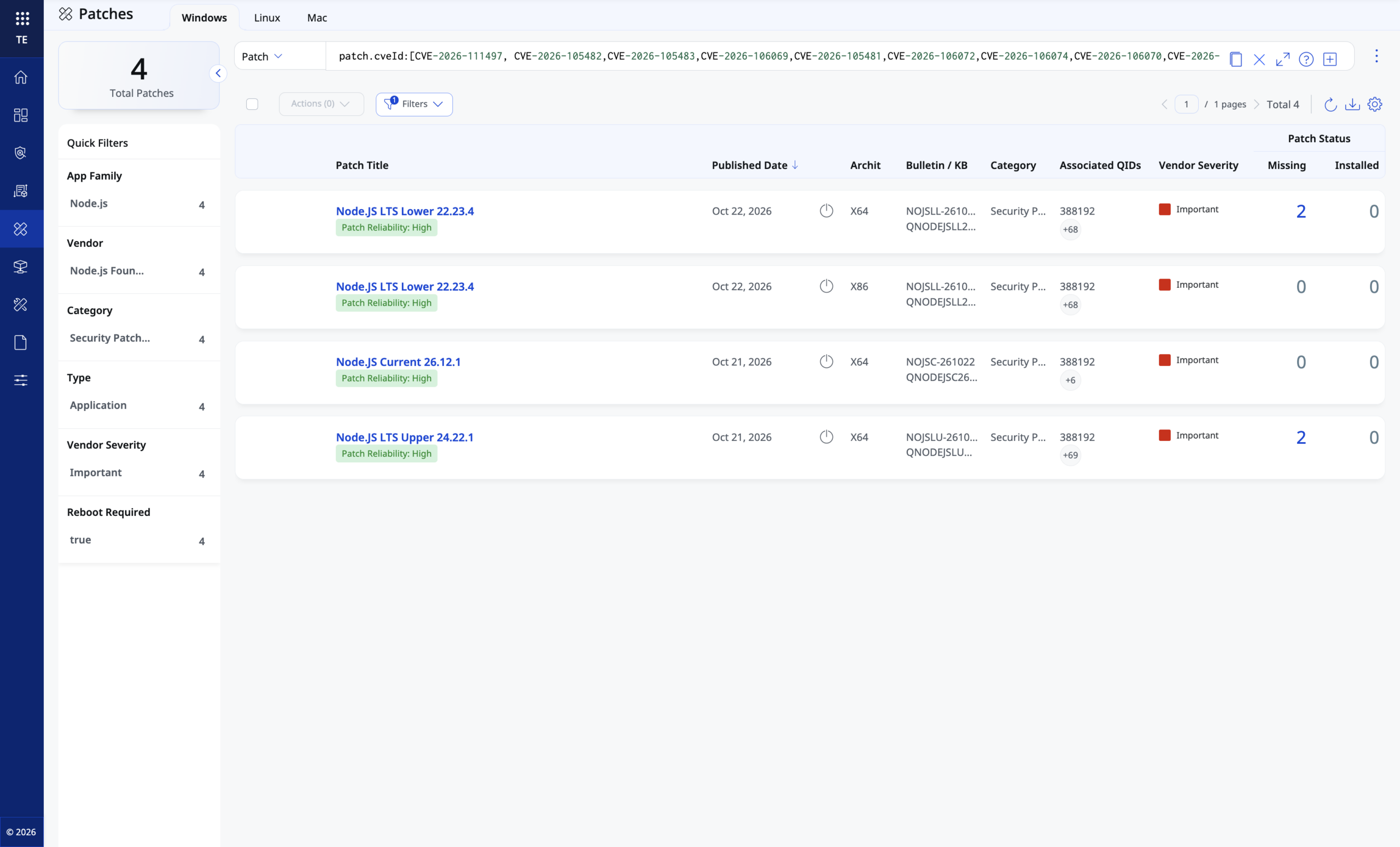
For the 22.x, 24.x and 26.x patches:
- Patch reliability: High for 22.23.4, 24.22.1, and 26.12.1. Qualys rates both patches with a High reliability score, so they’re unlikely to disrupt production.
- No OS reboot required. Node.js does not include kernel modules, drivers, or system services, so upgrading the runtime does not require a reboot.
- Restart every service that runs on Node.js. Long-running processes, containers and SEAs keep the vulnerable runtime in memory until they restart.
Once the relevant patch is successfully applied, the next VM scan marks the vulnerabilities on that host as closed.
Confirm That Remediation Is Complete
- Upgrade every copy. Move each supported line to 22.23.4, 24.22.1, or 26.12.1, and migrate end-of-life lines to a supported release.
- Rebuild what embeds the runtime. Rebuild container images and SEAs on the fixed version, then redeploy them.
- Restart long-running services, so they load the new runtime.
- Rescan and verify. Rescan with Cloud Agent or Container Security and confirm the detection QIDs are closed.
Connect Your AI Assistant to Qualys in Three Steps
You can now bring Qualys data into your AI workflows with qualys-cli-mcp, a Model Context Protocol (MCP) server for the Qualys Cloud Platform. Claude, Cursor, VS Code, and other MCP-capable assistants can use it to query your Qualys environment in plain language. For example, you can ask “Can you check in Qualys if I’m vulnerable to CVE-2026-111497 or any of the October 2026 Node.js vulnerabilities?″ without writing API calls or switching consoles.
| Step | Action |
| Install (requires Python 3.11 or later) | pip install qualys-cli-mcp |
| Configure your credentials | qualys-cli configure It asks for your Qualys username and password, automatically detects your platform, and securely stores the credentials in your OS keyring. Your credentials never go into the AI client’s config file. |
| Connect your AI client | For Claude Desktop, add this to claude_desktop_config.json (VS Code and Cursor use the same entry): { “mcpServers”: { “qualys”: { “command”: “qualys-cli-mcp” } } } |
That’s it. Your assistant can now work across Qualys.
What This Means for Security Teams
The crucial question after the release of the Node.js security update is not just, “Are we using Node.js?” but rather, “Where are all the vulnerable runtime installations, and which ones could be accessed by attackers?” Node.js runtimes can be found in various environments such as version managers, application directories, containers, serverless environments, and embedded deployments, often outside of standard installation paths. As these vulnerabilities impact the runtime itself, traditional application dependency checks may overlook them.
With Qualys, security teams can identify potentially affected Node.js runtimes immediately after a vulnerability is disclosed, including those installed outside standard paths and across various cloud and container workloads. Qualys helps prioritize remediation of internet-facing services that handle untrusted input. Teams can apply available patches using Qualys TruRisk Eliminate, manually upgrade runtimes as needed, and rebuild and redeploy affected container images or embedded runtimes. Follow-up vulnerability assessments ensure that remediation efforts have been successfully completed.
By integrating vulnerability detection, risk-based prioritization, supported patch deployment, and remediation verification into the Qualys platform, organizations can reduce their reliance on disconnected tools and accelerate their response to critical Node.js vulnerabilities, especially in cloud-native workloads with separate deployment pipelines.
Reference
Node.js Project: Wednesday, October 21, 2026 Security Releases