

Why AI-ROC Is the Future of Exposure Management

Executive Summary
Security teams have never had better visibility into their assets, vulnerabilities, and threats. What they lack is the speed to act on it. Frontier AI models are surfacing vulnerabilities faster than ever, attackers are using the same models to exploit them within hours, and most remediation still depends on scans, tickets, and change windows. Exposure management needs a new operating model that detects exposures as soon as they are disclosed, focuses only on what is proven exploitable, and remediates autonomously without breaking the business. That operating model is the AI-native Risk Operations Center (AI-ROC).
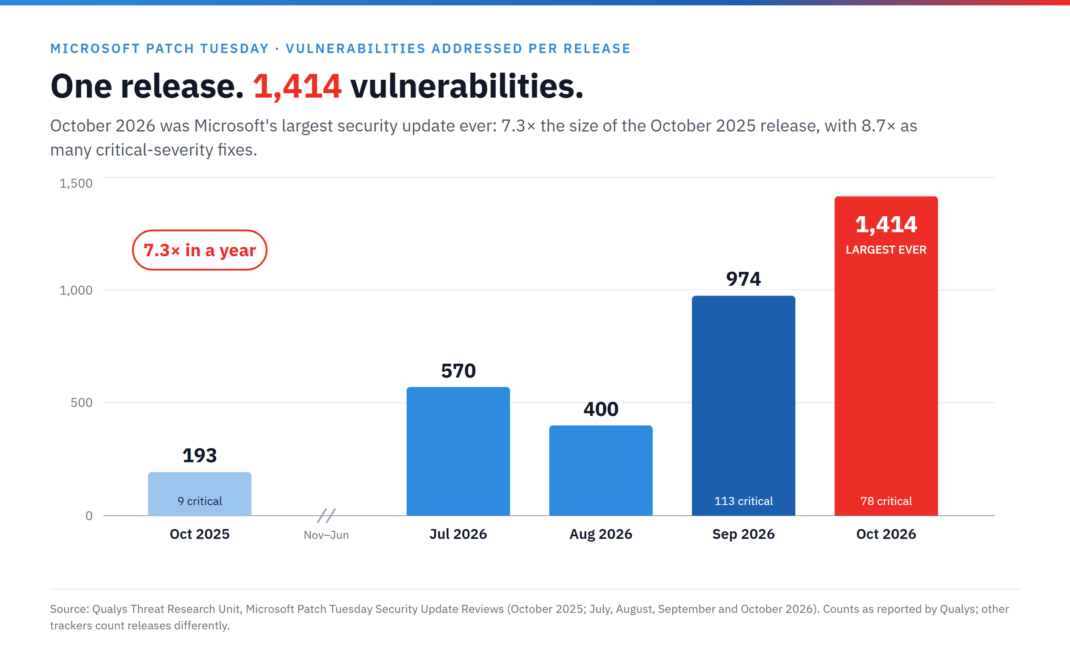
On October 13, 2026, Microsoft released the largest Patch Tuesday in its history, fixing 1,414 vulnerabilities. That is more than seven times the 193 vulnerabilities Microsoft fixed in October 2025. One of the new vulnerabilities was already being exploited, and the Cybersecurity and Infrastructure Security Agency (CISA) set a deadline of just three days to patch it.
At ROCon Americas 2026, we made the case that most organizations are focused on the wrong question. Knowing how many exposures you have is no longer useful on its own. What matters is how quickly you can turn those exposures into verified risk reduction.
The Vulnerability Surge Has Outpaced Remediation
Over the last twenty years, the security industry has gotten very good at finding things. Organizations now have more data on assets, vulnerabilities, misconfigurations, threat intelligence, and alerts than ever before. The ability to fix what matters has not kept up.
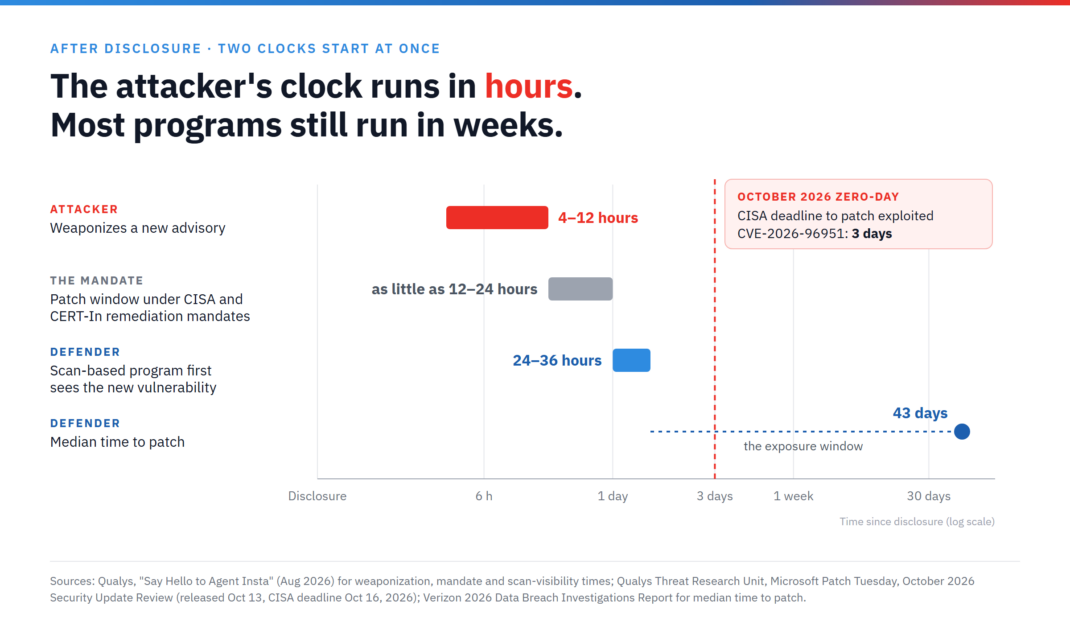
Frontier AI has made that gap much wider. These models are not creating new vulnerabilities. They are surfacing flaws that already existed in code, and they are doing it much faster than before. The last two Patch Tuesdays, with 974 vulnerabilities in September and more than 1,400 in October, show how fast this is moving. Attackers have access to the same AI tools and are using them to weaponize new vulnerabilities within hours. In September, two of the vulnerabilities Microsoft disclosed were already being exploited before a patch was available.
The way most organizations remediate has barely changed. A scanner detects the vulnerability, a second tool adds asset context, a third ranks it, an attack simulation tool tests it, and a ticket is created in the hope that someone fixes it within a 30- or 60-day service-level agreement (SLA). Each of those handoffs adds time, and risk only goes down when the fix is actually applied. This process was not built for attackers who move in hours.
What the Surge Means for Security Teams
Remediation timelines are shrinking from weeks to days, but the resources to meet them are not keeping pace.
- SLAs are moving from weeks to days. The 30- and 60-day SLAs most programs were built around no longer match the threat. Critical vulnerabilities now need to be patched in days, and mandates from CISA and CERT-In, the Indian Computer Emergency Response Team, can require remediation in as little as 12 to 24 hours.
- Exploitation is how most breaches now start. The Verizon 2026 Data Breach Investigations Report found that vulnerability exploitation was the leading way attackers got in, while the median time to patch grew to 43 days.
- Budgets and headcount are not keeping pace. Only 15% of security leaders expect their budgets to grow by more than 10%. Hiring more analysts is not a realistic answer.
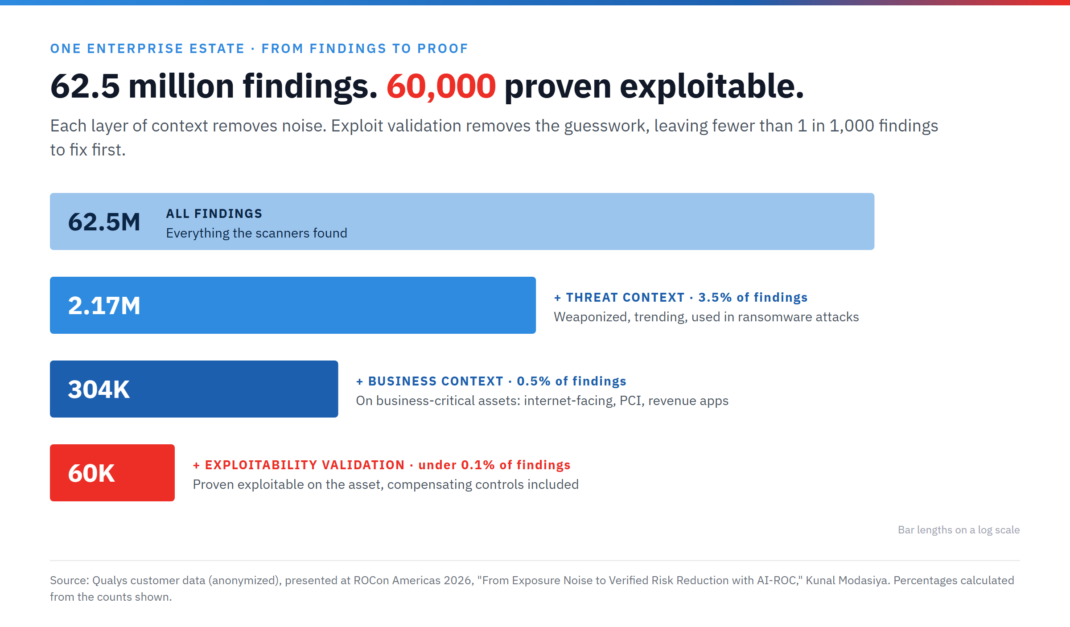
- There are too many findings to fix. One large Qualys customer had 62.5 million findings. No team has the time or budget to work through that many.
The Ideal Operating Model for Exposure Management
None of this is a new problem. Exposure management still comes down to the same basics of visibility, prioritization, and remediation. What has changed is the speed at which each of them has to happen.
- Detection must happen in real time. New exposures should be identified as soon as a vulnerability is disclosed, not after the next scheduled scan.
- Prioritization must be based on proof. Risk scores tell you what could be dangerous. Teams need to know whether an attacker can actually reach and exploit the vulnerability in their environment.
- Remediation must take hours, not a month. Low-risk fixes should be automated, and every fix should be checked to confirm it worked.
These steps also need to run on one platform. Every handoff between separate tools and teams adds delay, and that delay is the window attackers use.
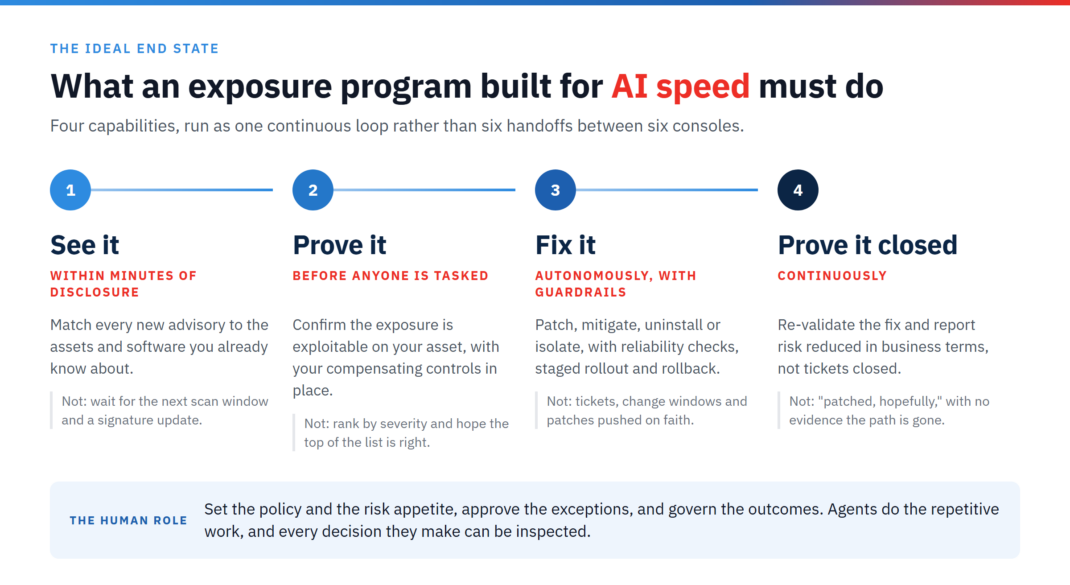
Qualys calls this operating model the Risk Operations Center (ROC). When AI agents handle the time-sensitive work at each stage, it becomes an AI-native ROC, or AI-ROC.
How Qualys Operationalizes the AI-ROC
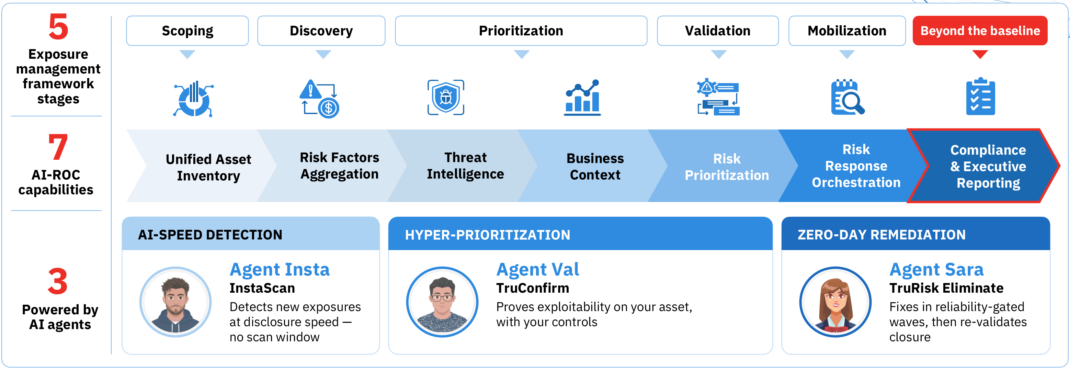
The Qualys AI-ROC brings this operating model together on the Qualys Enterprise TruRisk Management Platform. It pulls in every asset and exposure across cloud, on-premises, operational technology (OT), Internet of Things (IoT), mobile, and AI environments, enriches them with threat intelligence and business context, and then prioritizes and remediates the risk that matters. Three AI agents handle the work that has to happen at machine speed: Agent Insta for detection, Agent Val for validation, and Agent Sara for remediation.
AI-Speed Detection with InstaScan
With traditional scanning, a vendor has to write a detection signature, roll it out, and then customers have to rescan their environment. That can take a day or two before a team even knows it is affected. InstaScan, powered by Agent Insta, monitors vendor advisories around the clock and matches them against the asset and software data customers already have. No new scan is needed. After the October release, Agent Insta customers had detections within five minutes.
Hyper-Prioritization with TruConfirm
Even after applying threat intelligence and business context, a large organization can still be left with hundreds of thousands of findings. TruConfirm, powered by Agent Val, tests whether those findings can actually be exploited in the customer’s environment, using production-safe payloads that never download malware. For the customer mentioned above, this reduced 62.5 million findings to 60,000 that were confirmed exploitable.
Zero-Day Remediation with TruRisk Eliminate
Detection and prioritization only matter if the risk gets fixed. Before launching TruRisk Eliminate with TruConfidence, we kept asking why teams were not remediating faster. Automation was not the blocker, since patch automation tools have existed for years. Confidence was. Teams did not know whether they were choosing the right fix, whether a patch would crash a business application, or whether compensating controls already covered the risk.
TruRisk Eliminate with TruConfidence is built to answer those questions and to be the system of record and system of action for cyber risk reduction. It takes prioritized findings from Qualys or third-party tools and recommends the right fix for each one. A patch reliability score shows how likely a patch is to deploy without issues, and integrations with firewalls and other controls show when a compensating control already covers the risk. Patching is not always the answer. If a company has moved from Zoom to Microsoft Teams and a Zoom zero-day is disclosed, the right action is to uninstall Zoom rather than patch it.
Agent Sara plans the rollout. Low-impact updates such as browsers and standalone utilities are patched automatically with no reboot required. Production workloads are patched in rings, starting in a lab environment, with health monitoring through partners like Dynatrace. If CPU, memory, or network indicators show a problem, Agent Sara stops the rollout and rolls the patch back. When a patch is not safe to deploy, Agent Sara applies a mitigation instead.
Trust Is Built Into the AI-ROC
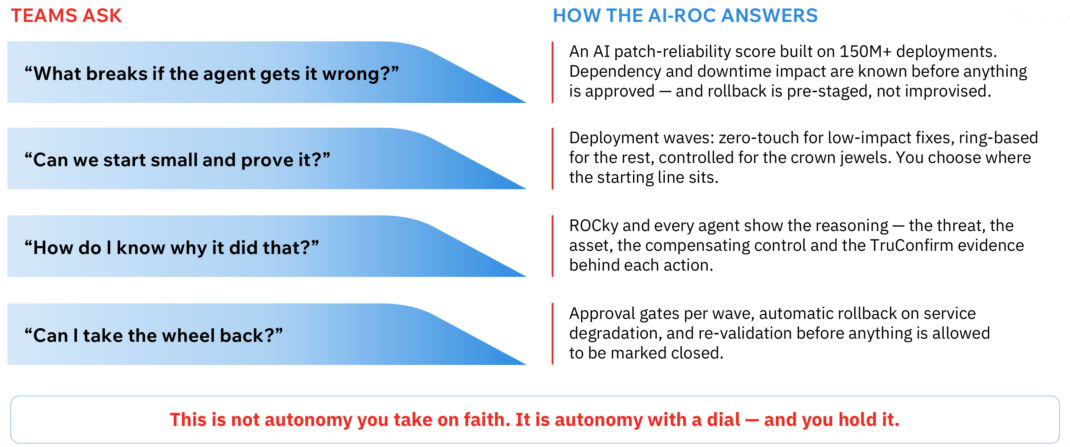
As soon as agents start remediating, security and IT teams ask the same four questions. The AI-ROC answers each one with a setting the team controls.
- What breaks if the agent gets it wrong? Every patch carries an AI reliability score based on real-world deployments. Dependency and downtime impact are known before anything is approved, and rollback is staged in advance.
- Can we start small and prove it? Deployment waves let teams start with zero-touch automation for low-impact fixes, use ring-based rollouts for everything else, and keep tighter control over their most critical systems. Each team decides where to start.
- How do I know why it did that? ROCky, the Qualys conversational AI interface, and every agent show their reasoning, including the threat, the affected asset, any compensating control, and the TruConfirm evidence behind each action.
- Can I take the wheel back? Each wave can have its own approval gate. Rollback happens automatically if a service degrades, and nothing is marked closed until it has been revalidated.
Policy, risk appetite, confidence thresholds, approval gates, and exceptions stay with the security team, and the agents work within those boundaries. Autonomy is not something teams have to take on faith. They control how much of it to use, and the program can grow with the environment instead of with headcount.
How the Three Agents Handle a Zero-Day
At ROCon, we walked through how the agents worked together on CVE-2026-81963, a Windows vulnerability from the September Patch Tuesday that CISA added to its Known Exploited Vulnerabilities (KEV) Catalog on the same day. Agent Insta detected it in the customer’s environment within minutes of disclosure. Agent Val confirmed it was exploitable on the customer’s assets. Agent Sara saw that the patch required a reboot and already had a low reliability score, so it deployed to the lab environment first. When health indicators showed issues, Agent Sara rolled the patch back and applied a temporary mitigation, reducing the risk without the patch ever reaching production.
What Comes Next for the AI-ROC
Organizations can adopt the AI-ROC in stages. The journey begins with AI-speed detection, then extends CTEM across every tool already in use, moves to autonomous risk elimination, and finally quantifies cyber risk in business terms for the chief information security officer (CISO), the chief financial officer (CFO), and the board. Each stage builds on the one before it, so teams see results early while working toward a fully autonomous program.
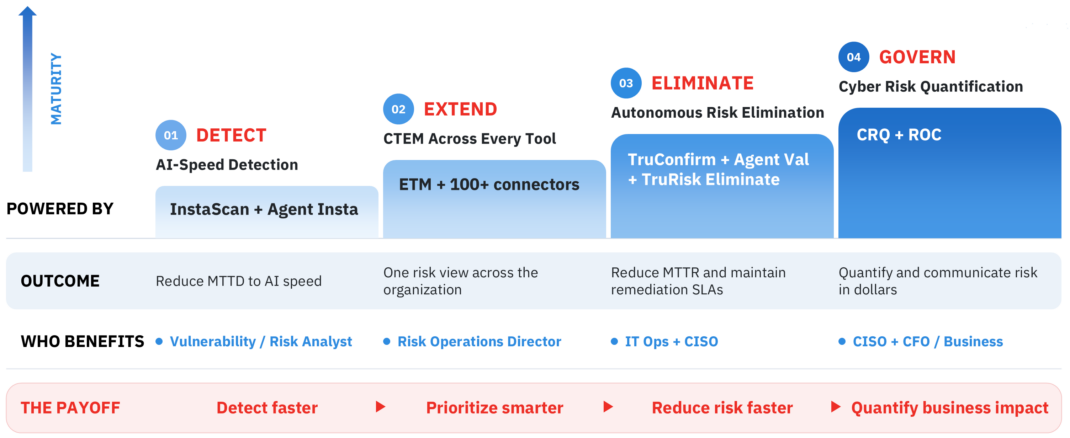
The AI-ROC will continue to grow with the attack surface. As applications, AI systems, and more advanced attack techniques create new kinds of exposure, they will come into the same platform, the same risk view, and the same agent-driven workflows.
Agentic ROC Studio and the Future of Agentic AI in Risk Operations
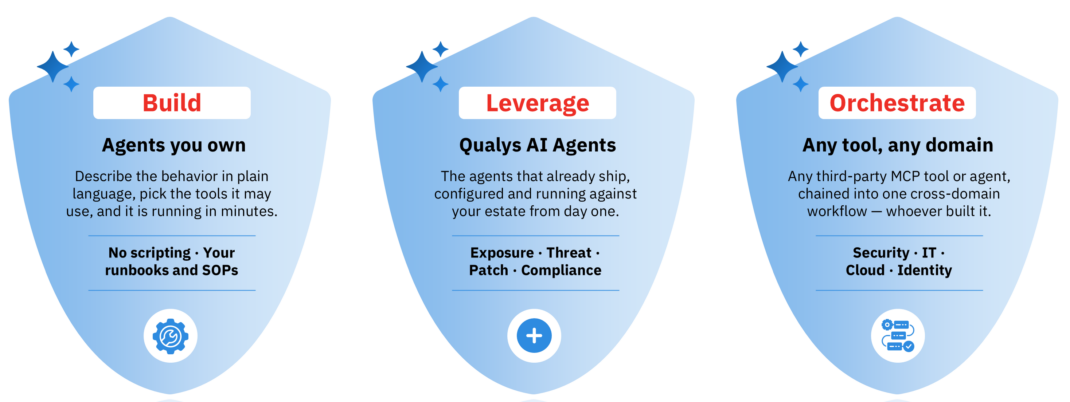
The next step is Agentic ROC Studio, a concept Qualys is building toward. Every security team has its own runbooks, its own tools, and its own way of working, and no set of prebuilt agents can cover all of it. Agentic ROC Studio is designed to let teams build agents around how they already operate. A team would describe what an agent should do in plain language, choose the tools it is allowed to use, and have it running in minutes, with no scripting required.
These agents would work alongside the Qualys AI agents for exposure, threat, patch, and compliance, and connect to third-party tools and agents across security, IT, cloud, and identity to run as one cross-domain workflow. That is where agentic AI in risk operations is headed: a digital workforce that takes on the repetitive work across the entire risk program, while the security team sets the rules and stays in the loop.
Conclusion
Frontier AI has changed the pace of vulnerability management. Record Patch Tuesdays have arrived for two consecutive months; attackers can weaponize new flaws within hours, and the SLAs most programs were built on no longer hold. Adding more scanners, more findings, and more tickets will not close that gap.
What closes it is an operating model built for AI speed. That means detecting new vulnerabilities as soon as they are disclosed, proving which ones can be exploited, and remediating them autonomously with safeguards that let teams trust the results. The AI-ROC brings all of this together on one platform, with AI agents doing the work at machine speed and security teams in control of every decision that matters.
Every tool on the market can tell you how many exposures you have. The organizations that stay ahead in the frontier AI era will be the ones that can answer a harder question: how quickly can we turn exposure into verified risk reduction?
Ready to see how the Qualys AI-ROC detects, validates, and remediates exposures at AI speed? Watch the full session from ROCon Americas 2026, then try it in your own environment with a free 30-day trial of Qualys Enterprise TruRisk Management (ETM).
Watch the Session Start Your ETM TrialFrequently Asked Questions (FAQs)
What Is an AI-ROC?
An AI-native Risk Operations Center. It detects exposures as soon as they are disclosed, proves which are exploitable, remediates with guardrails, and revalidates before closure. Security teams set policy and stay in control.
What Do the Three Agents Do?
Agent Insta handles detection. Agent Val handles validation. Agent Sara handles remediation, including reliability scoring, ring rollouts, and rollback.
Can the Agents Patch Without Approval?
Only within the boundaries the team sets. Low-impact updates can be zero-touch. Each wave can have its own approval gate. Rollback is automatic if a service degrades. Nothing is marked closed until it has been revalidated.
What Is Agentic ROC Studio?
A planned capability that will let teams build their own agents around existing runbooks, in plain language, with no scripting. Those agents will work alongside the Qualys agents and connect to third-party tools.
How Fast Does InstaScan Detect?
It matches new advisories against the asset and software data customers already have, so no new scan is required. After the October 2026 release, Agent Insta customers had detections within five minutes.